Personal Finance
How Big Should an Emergency Fund Be? Working It Out From Your Own Bills


The question is usually asked as a number of months, and the internet answers it quickly: three months, or six, depending on who is doing the talking. Here is the quiet problem with that answer. The multiple was never the hard part. Knowing your own monthly number is the hard part, and once you have that, the multiplication takes seconds.
So before you read on, one small step: open the notes app or take a piece of paper, and write down what your household genuinely spends on essentials in a month. Not the ideal month. The real one. The rest of this article is about making that number honest, and the widget below does the arithmetic with it.
If the number surprises you, stay with it for a moment. Most people’s essentials figure is higher than their guess and lower than their total spending, and both facts matter later: the first explains why the fund feels big, and the second explains why it is smaller than you feared.
Your emergency fund target
Enter the monthly essentials you worked out in the article and the months you want to cover. This is your own arithmetic, shown back to you.
Enter your monthly essentials to see your target.
Enter your monthly essentials to see your target.
No interest and no returns are calculated here. The target is your own essentials multiplied by your own months.
The total you worked out in the article. Essentials only, not lifestyle spending.
Optional. Leave it blank if you would rather just see the target.
What the fund is for
MoneySmart, the ASIC consumer site, defines the fund plainly: money you save to cover urgent or unexpected costs, such as car repairs, unexpected travel or an urgent medical bill. Those three examples are the ones to hold on to, because they share a shape. They are all things that arrive without warning, need money quickly, and cannot wait for a pay cycle.
A small problem that grows expensive is the fund’s native territory, and the site’s piece on the plumbing problems that start small and get expensive is the same pattern in the home: the cheap moment to act is early. The fund and the small repair are the same lesson at two different speeds.
That shape is also the best test for what the fund is not for. A holiday is not an emergency. A sale is not an emergency. A bill you knew was coming, like registration or a school term, is a planned expense, and it belongs in a different bucket. The fund has one job: to absorb the things nobody planned for, so they do not turn into debt. The three examples also share a timing, which is the pressure the fund removes: each one needs money before the next pay arrives, and a cost that can wait a fortnight is a cost the weekly budget can absorb.
The method, in the source’s own words
MoneySmart’s method is one sentence, and it is quoted here rather than paraphrased: work out your monthly expenses, then multiply this by the number of months you would like to cover. That total can be your savings goal.
A worked example makes the shape concrete. These are made-up figures, chosen to be round, and they are not a suggestion about your own. Suppose your monthly essentials come to $2,400 and you decide to cover three months. The target is $7,200. At $50 a week, that target takes 144 weeks, which is a little under three years. The sums are the easy part; the two numbers going in are the ones that need care.
The same multiplication answers the other common question, about six months rather than three. At $2,400 a month, six months is $14,400, which is where the six-month recommendations come from: the same two inputs, a different choice in the middle. Nothing about the method changes when the number of months changes, which is why the widget asks for both rather than deciding for you.
The widget above does the same multiplication with your own figures, and it shows the inputs back to you so you can see the arithmetic rather than a magic number. That visibility is deliberate, because the multiplication is the part people try to skip, and skipping it is why a fund so often stays a slogan. Three months of a number you have not written down is not a target; it is a mood. The widget refuses the mood, because it needs the number first.
That is also the way to use the widget well: it is only as good as its two inputs. If the monthly figure is a guess, the target is a guess with a dollar sign on it, and the weeks-to-go figure inherits the same wobble. This article spends its length on the inputs for that reason, and the multiplication can look after itself.
The first number, found carefully
The monthly figure is where self-deception lives, and it deserves care. Start with the regular bills: rent or mortgage, power, water, phone, insurance, transport, childcare. Then add the weekly costs that never feel like a bill but always are: groceries, fuel, the chemist, the pet food. Then find the annual expenses, like registration or a yearly policy, and divide each by twelve, because they are part of a month even when they are not in every month.
The part that matters is what you leave out. Discretionary spending, takeaway, the subscriptions you are not sure about: those do not belong in the emergency number, and saying that out loud matters. The fund covers essentials, not lifestyle. If building the figure proves hard, MoneySmart points readers at a budget planner, and that is a perfectly good place to start; the same discipline of running the numbers instead of guessing is what the site’s guide to tax planning through the year applies to a different deadline.
One practical tip for the annual expenses: gather them from the last twelve months of statements rather than from memory. Memory arranges the year the way it felt; statements arrange it the way it happened.
The two hardest lines in the figure are the annual expenses and the weekly ones, and they are hard for opposite reasons. The annual bills are easy to forget precisely because they are rare, which is why dividing them by twelve belongs on paper. The weekly costs are easy to under-count because they are frequent, and small, and paid without ceremony; the groceries, the fuel and the chemist are the lines that quietly decide whether the monthly figure is honest.
A number that is too high is its own kind of failure, because the fund looks impossible and never gets started. A number that is realistic is a number you can make progress against.
The pace, and the patience
MoneySmart offers an arithmetic that belongs on the fridge: $20 a week into a savings account is over $1,000 in a year’s time. The point of the line is not the $1,000. It is that small, regular amounts build a buffer, and the buffer is the thing that changes how a bad week feels.
The limit deserves stating plainly too. At $20 a week, a full fund takes years, which is why the fund is built in the background rather than by willpower. An automatic transfer does the work once it is set up, and the amount can rise when a pay rise arrives. Nobody is asked to be heroic about this. They are asked to be regular. The pace is not competing with this month’s budget either; the fund runs alongside the budget rather than against it, and the transfer is what keeps it running when the month is busy.
The weekly amount is also the dial that makes the plan survive. A transfer that is too ambitious gets cancelled in a tight month, and a cancelled transfer is worse than a small one, because it breaks the habit along with the plan. Setting the amount at a level the household will not miss is not a failure of ambition; it is the reason the rest of the arithmetic gets a chance to run.
Where it lives
The source’s first practical step is a sentence with a whole mechanism inside it: use a separate savings account. The separation is not tidiness. It is the design. Money in the everyday account is available to the week, and the week always has a use for it. Money in a separate account has to be fetched deliberately, which is exactly the friction the fund needs.
The reader’s other question deserves a plain answer too: yes, the fund and ordinary savings can coexist. Ordinary savings pay for the planned things, like the holiday and the new washing machine. The emergency fund covers the unplanned, and it keeps its one job. Two accounts, two purposes, and the emergency account is the one you do not raid for a sale. Separation also answers the question of whether the money should be visible. It can be visible; it simply should not be spendable by reflex, and an account that requires a deliberate transfer is exactly that.
One more thing about what separation is not. It is not a lock, and it is not a judgement about willpower; the fund is meant to be reachable in the week it is needed. The separation is a speed bump, and a speed bump is all it needs to be: enough friction that the money is fetched on purpose rather than spent on the way past.
When life is bigger than the fund
One line from MoneySmart belongs here, stated as the source states it and not stretched beyond that: insurance is the complementary protection for a reader who cannot work. That is the whole of the sourced position on the subject, and this article stops where it stops, because comparing products is a different job with different rules.
The same restraint applies to the other fixed costs that compete with a fund. A repayment on a car loan, for example, is part of the monthly picture, and it competes directly with the transfer you are trying to protect. That is a decision for the household’s own numbers, and this article does not make it for you.
The number, and the account
The five-minute version of this article is four steps. Write your monthly essentials figure down, honestly. Run it through the widget above, or multiply it on paper if you prefer, and choose the number of months you are aiming to cover. Open a separate savings account, if you do not already have one. Then set one automatic transfer, small enough that it will not be cancelled in a hard week.
The three-month target is MoneySmart’s starting point, and it is a good one, but the number that matters is the one your own bills produce. Start where you are, build it in the background, and let the fund do the one job it was made for. And one last thing, because it is the part that makes the number real: write the target down where you will see it, next to the account. A target that lives in a notes app is a target; a target that lives beside the transfer is a plan.
Sources: MoneySmart – Save for an emergency fund











Buy now, pay later is sold as convenience with no cost attached. The convenient half is true. The no-cost half is not, and it never was.
MoneySmart, the ASIC consumer site, sets out the position in its own words. You usually pay no interest on a buy now pay later purchase, and instead you are charged fees. Applications, late fees and the arrangement itself might appear on a credit report. Late or missed payments can be reported, and they can reduce a credit score.
The distinction that matters is between a payment method and a credit product. Buy now pay later is the first one, and in a lender’s file it behaves a little like the second.
A service that is free at the counter is not free of consequences. MoneySmart’s own page says so.
Here is the position, up front. The instalments are not the problem. The applications and the missed payments are. Interest free is a description of one fee, not of the whole arrangement, and the gap between those two ideas is where the trouble lives.
None of that makes the service dishonest. It makes the phrase interest free carry more weight than it can hold. The rest of this article is the detail behind that sentence, and it is worth five minutes before the next tap.
How the payments work
The mechanics take thirty seconds to understand, because the fees live in them. A purchase is split into instalments: commonly four payments over six weeks for small amounts at the checkout, with longer schedules for larger purchases. In the usual case the customer pays no interest.
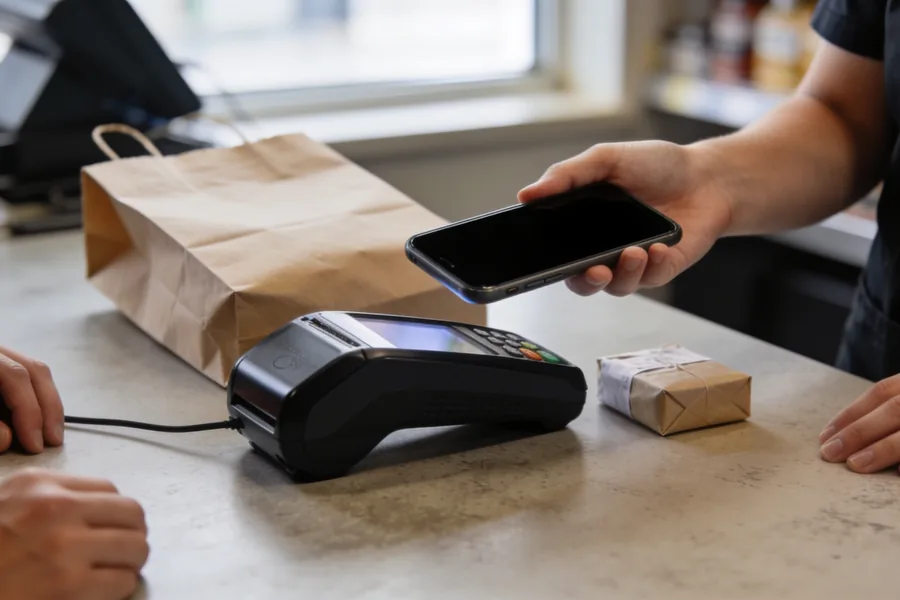
The schedule is not a decision, either. Four payments over six weeks is a rhythm the checkout sets, and the decision is whether a second arrangement starts before the first one finishes.
The merchant pays the provider for the service. That is why nothing at the counter feels like borrowing, and why the price of the service never appears on the sign. It appears later, by type.
MoneySmart lists the fees that can apply: late fees, monthly account-keeping fees, payment processing fees and establishment fees. Those are the provider’s fees, and they are only half of the list. That is four types of fee from one provider, before the bank gets involved, and none of them appears in the advertising.
The bank-side costs sit on top of them. If the account cannot cover a repayment, an overdrawn fee can follow. If the repayment is made on a credit card, card interest can follow it. A repayment moved onto a card is a repayment that can start costing money at both ends. Both lists are knowable in advance.
None of that is hidden, and none of it is unusual. It is simply not at the counter, and it does not need to be there, because the decision is made in four seconds and the fees arrive in four weeks.
The shape is a convenience fee, spread out and named differently in each clause. That does not make it wrong. It makes the contract something to read.
A worked example makes the shape clearer, without a dollar in it. A repayment that lands on a card is both a repayment and a card balance, and the card balance can start costing money from the day it is created.
The instalments are only one part of the cost. The card behind them and the date they land are the other two.
The four-second decision is what the checkout is designed for, and the design is not the problem. The problem is that nothing in those four seconds mentions a credit file.
The credit file question, answered
The answer is in the source’s own terms, not the marketing’s.
Every time a person applies for buy now pay later, it may trigger a credit check. That much is routine. The problem is volume: a lot of credit checks on a report can influence a credit score and act as a red flag for lenders.
The arrangement, any late fees and the application may appear on the credit report. Lenders consider that history when a person applies for something larger, such as a car loan or a mortgage.
Read that list slowly, because it is wider than it looks. The arrangement, the fees attached to it and the application that created it are all candidates for the report. None of them is a missed payment, and all of them can still show up.
Late or missed payments can be reported, and they can reduce a credit score. That is the sentence that matters most, and it is the one the advertising never mentions.
The word doing the work in all of it is may. It is not will, and it is not never. That is the whole nuance, and it is enough to change how a sensible person uses the service. The may word cuts both ways. It is a caution rather than a ban, and it is answered by habits rather than by avoidance.
So there are three credit-file events to keep apart: a missed payment, a run of applications, and the arrangement itself. They are not the same event, and the source treats them differently. What matters is knowing which of the three a person is creating on any given day.
The events are also cumulative in a way that is easy to miss. A single application is one line; a habit of applications is a pattern, and a pattern is what a lender reads. None of this is exotic. It is the ordinary way credit files work, and the arrangement is now ordinary enough to be part of them.
A person who clears every instalment on time builds nothing on their file and damages nothing on it, which is the boring truth underneath all the noise.
The moment this lands hardest is the moment of a bigger decision. A lender weighing a car loan reads the same file and asks the same questions, and the site’s piece on whether refinancing a car loan is worth it works through what a file has to show before a larger commitment is made. The same file, read from the funding side, is the subject of the site’s guide to truck finance that grows with a business.
That is also when the arrangement stops being theoretical: the application that felt like a checkout is, in that file, an application, and the file keeps a memory that the checkout does not.
The verdict is narrow, and it is not an argument against buy now pay later. The file is not damaged by using the service well. It is damaged by missing a payment, and it is damaged by applying everywhere at once.
The fee caps most people never check
Some buy now pay later arrangements must have limits, or caps, on the fees they can charge. That protection exists. Most users have never looked for it.
The way to know whether it applies to the arrangement in front of you is to check the contract, which is the document nobody opens. That is the whole instruction. Check the contract.
If the contract is not at hand, that is the first problem to solve. An arrangement whose terms a person cannot find is an arrangement running on trust, and trust is not a fee cap.
The other half of the same point is what the advertising claims. Interest free is a statement about one type of fee. It says nothing about late fees, account-keeping fees, processing fees or establishment fees, and it says nothing about what happens to a credit file when a repayment is missed.
Fee caps are also the reason the contract matters more than the counter conversation. The person at the counter cannot tell you the cap; the document can.
A cap is not a discount, and it is not a promise that the arrangement is cheap. It is a ceiling on one category of charge, and knowing whether yours has one is the first question on the list below. The contract is also the only place the answer exists; there is no app screen that shows a cap and no counter conversation that settles it.
The quieter option: lay-by
MoneySmart makes a comparison most people have not considered. Lay-by has no account-keeping fees and no late fees, which makes it the cheaper shape for the same purchase.
The trade is the take-home date. With lay-by the goods stay behind the counter until the final payment rather than coming home on the first one. For anyone who knows the money will be paid off either way, that is a straight trade.
Lay-by is the slower shape and the cheaper one, and it is the comparison the source puts on the table. It asks for patience and gives back the fees. The trade is old and unexciting: pay first, take the goods later. It will not suit everyone, because the goods stay in the shop, and for some purchases the waiting is the whole objection.
When it goes wrong, ask early
The failure mode is rarely the fee. It is the silence after a missed payment, which is the point at which a conversation is still possible.
All buy now pay later providers are required to have complaints and hardship services, which means there is a route to take before a missed payment becomes three. MoneySmart’s instruction for financial hardship is to take action straight away and ask the lender for hardship assistance, then consider the options offered and make the arrangement. Asking for that assistance is a normal use of the process the providers are required to keep, and using it early is what keeps a small problem small.
Asking early keeps it a conversation. Asking late is where a missed payment can reach the credit file.
The order of the steps matters as much as the steps themselves. Take action, ask for assistance, consider the options, make the arrangement: the source sets it out in that sequence, and each step depends on the one before it.
Financial counselling is free and confidential, through the National Debt Helpline on 1800 007 007, weekdays from 9:30am. It exists for exactly this situation, and reaching for it is a practical decision rather than an admission.
What to check before you tap
Four questions, before the next purchase. They take five minutes, and each one has a reason behind it.
- Is there a fee cap in the contract, and does the contract say so in plain words? Some arrangements must carry one, and the contract is where it lives.
- Which card sits behind the repayment, and what happens on the due date if that card is empty? An overdrawn fee and card interest both start with that card.
- How many services are running at once? MoneySmart’s own warning is that multiple services are hard to manage, and a person running three is running three deadlines.
- What is the plan if this month goes wrong? The providers keep hardship services for that question, and an answer is easier to reach before it is needed than after.
None of the four takes long, and each one is cheaper than the alternative it prevents. That is the whole argument for the five minutes before the tap.
The checklist is short on purpose. A long list before a small purchase would be its own kind of noise, and the four questions above are the ones with money attached. They also get faster with practice: the first tap after the checklist takes five minutes, and the ones after it take two.
The service is a payment method, not a trap. It is a payment method with a credit file attached, and a credit file is the part that follows a person to the next loan application. Tap with that in mind and the arrangement stays what it was sold as.
Sources: MoneySmart – Buy now pay later services · MoneySmart – Financial hardship


 Healthcare1 year ago
Supported Independent Living Explained: What SIL Covers and Who It Suits
- Food1 year ago
Balance Your Plate, Boost Your Mood: Beginner’s Guide to Eating Well
- Healthcare1 year ago
Oral Health at Every Age: What Changes and What to Watch For
- Healthcare1 year ago
The Allergy You Can’t See: How to Detect and Manage Silent Food Reactions
- Healthcare1 year ago
Occupational Therapy for Children: The Signs It Could Help, and How to Start
- Business1 year ago
Connections That Count: Why Networking Is Still Crucial for Business Success
- Healthcare1 year ago
Tired of Plantar Fasciitis Pain? Shockwave Therapy Could Help You Get Back on Your Feet
- Healthcare1 year ago
Home and Living Support Under the NDIS: What It Funds and How It Fits a Plan