Home & Garden
Polycarbonate Roofing: Where It Works and Where It Does Not

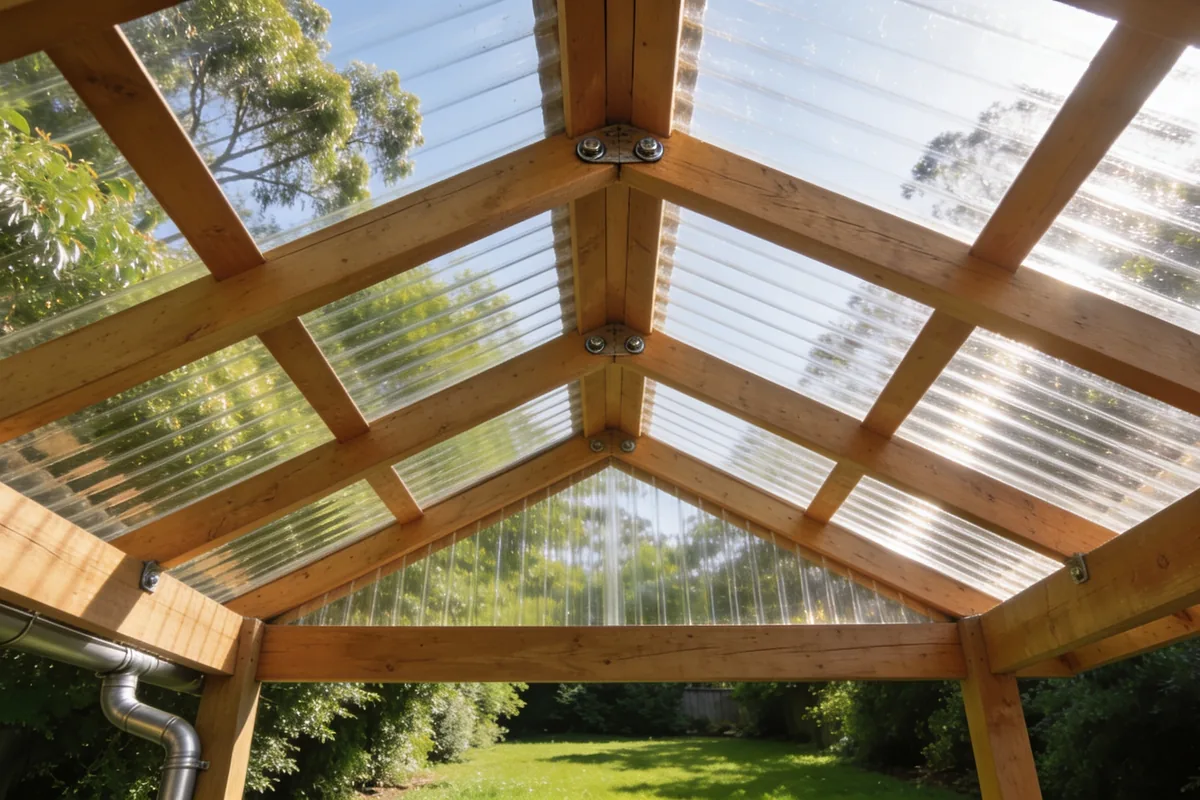
Polycarbonate sheet is a roofing material for the places where a solid roof is more than the job needs and no cover at all leaves the space unusable. It is commonly used over pergolas, verandahs, carports and walkways, and it is chosen for three practical reasons: it is light, it admits daylight, and it does not demand the structural support that tile or concrete requires. It also carries two conditions that decide whether it suits a particular job. The first is how much heat builds beneath it under an Australian summer sun. The second is how much noise it makes when rain falls on it. Both are manageable. Both are cheaper to understand before the sheets are ordered than after the frame is built.
What polycarbonate sheet is
Polycarbonate is a thermoplastic. For roofing it is supplied as rigid sheets in several constructions, and the differences between them matter more than the brand on the packaging.
Twin-wall sheet is two layers joined by internal ribs, with air channels running between them. Multi-wall sheet repeats that structure through several layers, which makes it stiffer and slower to pass heat through, at the cost of some clarity. Solid sheet is a single layer and behaves differently again: it is clearer, heavier and more expensive for the same area. Sheets intended for outdoor work carry a UV-resistant face, and that face is installed upwards. The supplier identifies which side the coating is on, and the manufacturer’s instructions should be followed on that point without exception.
Relative to glass of comparable thickness, polycarbonate withstands impact far better, which is why it is common where hail or falling branches are a realistic concern. It is also lighter, which is what allows a domestic timber frame to carry it.
Where it works
A covered outdoor area is the natural use. A pergola over a courtyard, a verandah along a wall, a carport, a walkway between the house and the shed, and a shelter over a barbecue or a pool pump all suit a material that lets light through and can be fixed to a simple frame.
Three conditions decide the details. The first is span. The wider the unsupported distance, the thicker and stiffer the sheet must be, and the closer the support timbers or purlins must sit. The second is pitch. Water must be able to run off, and the fixing method changes with the slope. The third is attachment to the house. A structure fixed to a dwelling, or built close to a boundary, can require approval depending on its size, its setback and the rules that apply where the property sits. Councils rely on plans prepared by a licensed surveyor for matters of boundary and siting, and what such a plan certifies, and what it does not, is set out in our guide to council and building compliance.
Where it does not
There are jobs for which polycarbonate is the wrong answer, and it is better to know them at the start.
As the primary roof over a habitable room, sheet plastic is rarely the first choice. A metal roof or tiles insulate and muffle sound more effectively, and they hold their appearance over a longer service life. A clear sheet also lets in light that a bedroom or living room may not want, and it will show dirt and pollen in a way that an opaque roof does not.
Long spans without intermediate support are a second poor fit. The material is light, not rigid, and it flexes. Where the span is long, the frame has to do more work, and at some point metal sheet becomes the simpler proposition. What the profiles are, and what to check before buying them, is covered in the guide to metal roofing options.
A third case is the position directly beneath a bedroom window, where the noise question below decides the sheet choice.
The heat question
Clear polycarbonate admits daylight, and daylight carries heat. In full summer sun, the space beneath a clear sheet can become uncomfortable in the middle of the day, and the effect is strongest where the covered area is enclosed on two or more sides and the air cannot move through it.
There are three practical responses, and they are usually combined. A tinted sheet, in bronze, grey or opal, cuts both glare and heat, at the cost of some light. A heat-reflective sheet is made to reject more of the sun’s heat while keeping more light than a dark tint. And ventilation, whether open sides, a ridge gap or a fan, does as much as either sheet choice, because trapped air is what turns a warm space into an unbearable one.
The choice between them is a matter of what the space is for. A carport can afford a darker tint. A sitting area needs the light tested in the afternoon, not chosen from a sample under a shop’s lighting.
The noise question
Rain on any roof makes noise. On polycarbonate it is louder than on tile, and the frame underneath changes how loud it seems. A metal frame transmits vibration more readily than a timber one, so the same sheet over the same span can sound noticeably different depending on what holds it up.
Two adjustments reduce the problem. A thicker multi-wall sheet is quieter than a thin twin-wall sheet, because the extra layers and air channels absorb more of the sound. A timber frame, or an insulating layer between sheet and frame, removes some of the drumming as well. Where the covered area sits beside a bedroom, the sheet choice and the frame choice deserve to be made together, and with the noise in mind rather than as an afterthought.
Choosing between the sheet types
The decision comes down to what the space needs from the roof.
Twin-wall sheet suits a carport, a walkway or any cover where light is welcome and the span is modest. It is the lightest and usually the least expensive of the roof-grade options, and it does the job where the space below is not somewhere people sit for long periods.
Multi-wall sheet suits a sitting area, or any position where the noise matters or the span is longer. It is stiffer for the same thickness, quieter in rain and better at slowing heat transfer, and it costs more and passes less light. Where a supplier stocks both, the two samples side by side, held up against the sun, answer more questions than a specification sheet does.
Solid sheet is the third option and the least common over a whole roof, because it is heavier and more expensive. It earns its place in smaller positions, such as a highlight strip within another roof, where clarity is the point.
Fixings and movement
Polycarbonate expands and contracts with temperature more than the frame it is fixed to, and the fixing method must allow for that movement. The practical points are standard across manufacturers: holes drilled slightly larger than the screw, washers that cushion the sheet, screws set so the sheet can move without being held rigid, and no over-tightening at any point. The manufacturer’s fixing instructions exist for this reason and should be followed as written.
The frame deserves the same attention. Purlins or battens at the spacing the sheet manufacturer specifies, timber that is dry and straight, and a fall that takes water to a gutter or clear of the structure. Most complaints about a plastic roof trace back to the frame or the fixings rather than the sheet.
What to check before you buy
- Confirm the sheet thickness and profile suit the span and the fixing centres, using the manufacturer’s span table rather than an estimate.
- Confirm which face carries the UV protection and that it will be installed upwards.
- Decide the tint with the afternoon sun in mind, and ask to see the sheet against the light.
- Ask what the warranty covers, particularly yellowing and hail, and what it requires of the installation.
- Check the frame material and the fixing method together, since the two decide how loud the roof will be in rain.
- Establish whether approval is needed for a structure attached to the house or close to a boundary before any work starts.
- Plan how the sheets will be cleaned, because dust, pollen and leaf litter all show on a translucent roof.
Polycarbonate sheet is usually bought through a roofing supplier such as Singh Roofing Supplies rather than a general hardware store, and it is worth taking the frame measurements with you when you go.
What it comes down to
Polycarbonate roofing is a good answer to a specific question: how does a light, open, covered outdoor space get built without the weight and cost of a tiled or metal roof? It is a poor answer to a different question, which is how a habitable room gets a permanent roof. Within the first question, the sheet type, the tint and the frame are the three decisions that decide the result, while heat and noise are the conditions that determine whether the space will be pleasant or merely covered. A buyer who settles those five matters before ordering has the job under control.
Sources: Wikipedia, “Twinwall plastic” (en.wikipedia.org/wiki/Twinwall_plastic); Wikipedia, “Polycarbonate” (en.wikipedia.org/wiki/Polycarbonate).











So you’ve got a punnet of tomato seedlings on the back step, the weather has turned mild, and somebody has already told you to wait for Melbourne Cup Day. Maybe it was your nan, maybe a neighbour over the fence. Almost everyone has someone who swears by it, and you might be wondering whether it’s wisdom or just habit.
It’s a bit of both, and that’s good news. The Cup Day rule has a real reason underneath it, and once you know the reason you can work out whether the date suits your garden. This year Melbourne Cup Day falls on Tuesday 3 November 2026, according to Business Victoria. Whether that’s the right day for you depends far more on your soil and your last frost than on a horse race.
What the rule is really protecting
Tomato seedlings are frost tender. A cold night that leaves a hardy winter crop untouched can blacken a young tomato plant, and that’s the loss the old rule was built to prevent. Gardeners picked a date late enough in spring that frost had usually passed, and the Cup was a date everyone remembered.
Here’s the part that surprises people. You don’t need a reading of zero on the thermometer to get frost. ABC reporting on frost explains that it can form when the air is a little above 0 degrees, depending on humidity and cloud cover. A clear, still night can catch you out even when the forecast low looks safe enough.
The other half of the story is the soil. Gardening Australia’s guidance is that soil should be at least 16 degrees for tomatoes, with 18 to 20 degrees better still, and that you should plant after the latest chance of frost, which in cold areas is usually the first week of November. So there are really two tests, and the date on the calendar is only a rough stand-in for both of them.
Spring warming is gradual, and you can see it all around the garden. The same lengthening days that bring a winter-battered lawn back to green are slowly warming your vegie bed from the top down.
One small step for this week: check the forecast overnight lows for the next seven days, and notice how clear and still the nights are meant to be.
Melbourne and cool Victoria: the rule mostly holds
If you garden in Melbourne, your nan was largely right. Early November sits after the frost risk for most of the city, and by then the soil in a sunny bed has usually had time to warm. Planting on or around Cup Day is a sensible, low-fuss choice for a lot of Melbourne gardens.
That said, Victoria isn’t one climate. Colder inland towns and hill areas can stay frosty later into spring than the suburbs near the bay, so if you’re up in the ranges or out on a cold plain, you may need to wait a little longer. That’s fine, and it isn’t a sign you’re doing anything wrong. Waiting for your own conditions is exactly what the rule was trying to teach in the first place.
It can help to think of the year as a calendar of small jobs. In the same way that there’s a right time for what to prune in June, there’s a right window for tomatoes, and it’s set by the conditions rather than a fixed date.
One small step: push a soil thermometer into the bed where the tomatoes will go, and read it in the morning for a few days running. When it’s sitting at 16 degrees or more, you’re in business.
Canberra: slightly early
If you’re in Canberra, the rule needs a gentle adjustment. ABC News looked at Canberra frost data going back to 1940 and found that the final morning of potential frost has fallen, on average, two days after Melbourne Cup Day. So planting on the day itself means planting just before the average last frost.
The same analysis went further, and it’s worth laying the numbers out as choices rather than rules:
- About two days after Cup Day: the average final frost. Planting here is a coin toss on whether a cold morning is still coming.
- 17 days after Cup Day: the point at which you can be 80 per cent confident of avoiding frosty nights. The ABC nicknamed this “Tomato Friday”.
- 43 days after Cup Day: 95 per cent confidence, which takes you well into December.
None of these is wrong. It comes down to how much risk you’re comfortable with and how much effort you’ll put into protecting the plants. If you don’t mind throwing a cover over seedlings on a cold night, an earlier start is fine. If you’d rather plant and forget, waiting for Tomato Friday is the calmer path.
One small step: if you plant in early November, keep something to cover your seedlings handy right through the month, and check the forecast each evening.
Brisbane and the subtropics: late
In Brisbane, it’s a different story, and you may be relieved to hear that you haven’t missed anything by ignoring the Cup. The thing to watch there is the heat. By November, the heat and humidity are building, and with them comes more pressure from pests and disease, which tomatoes don’t love.
The general warm-climate pattern is to plant earlier, from late winter to early spring, and again in autumn, so the plants do their main growing in milder weather. If you’re reading this in late October in Brisbane with no tomatoes in yet, you haven’t failed. You might simply be looking at an autumn crop instead.
One small step: if you’re in the subtropics, jot down a reminder for late summer to plan an autumn planting, and give this spring’s bed to something that enjoys the heat.
Planting well on the day
Whenever your day comes, the way you plant matters as much as the date. Gardening Australia recommends planting tomatoes deep. You bury the stem so that only the top leaves sit above the soil, and you take off any leaves that would end up underground. Roots then form along the buried stem.
It feels a little odd the first time, burying most of a seedling you’ve been nursing along. If yours have gone tall and leggy on the windowsill, though, this is good news, because the stretched stem is the part that goes underground.
Light is the other big need. Gardening Australia suggests a spot in full sun, about seven hours a day in cool areas. If your yard is shady, the sunniest spot you have is worth more than the richest soil in a dim corner. A raised garden bed can help here too, because you get to put it wherever the sun falls longest.
One small step: on planting day, dig each hole deeper than feels natural, strip the lower leaves, and water the seedlings in well.
If you’ve already planted early
Maybe the sun came out in mid-October and you couldn’t help yourself. That’s completely understandable, and it isn’t a disaster. Plenty of early tomatoes come through fine with a little care on the nights that matter.

The main thing is to protect them on cold, clear nights. A simple cover over each plant in the evening keeps the worst of the chill off, and you lift it off in the morning so the seedling gets the sun. Watch the forecast, and pay most attention to nights with no cloud and no wind, which are the ones most likely to bring frost.
And if a seedling does get hit and doesn’t come good, try not to be hard on yourself. In cool areas Gardening Australia puts the usual planting time in the first week of November anyway, so a replacement planted then is right on schedule.
One small step: find your covers now and keep them by the back door, so you’re not hunting for them at nine o’clock on a frosty night.
A few questions people ask over the fence
“It’s late October in Melbourne. Can I plant out now?” You might well be able to, and it’s a fair question to ask. Rather than counting days to the Cup, run the two tests. Is the soil in the bed reading 16 degrees or more in the morning? Is the week ahead free of clear, still, cold nights? If both answers are yes, planting a little before the race is unlikely to hurt, as long as you keep a cover handy for the odd chilly evening.
“My seedlings have gone tall and floppy. Have I ruined them?” Not at all. It happens a lot with seedlings raised on a windowsill. Gardening Australia’s deep-planting method suits leggy plants nicely, because the long stem goes underground, the buried leaves come off, and roots form along it.
“I’ve always planted on Cup Day in Canberra and it’s been fine.” That’s genuinely worth something, and nobody is saying you’ve been doing it wrong. On the ABC’s numbers, though, Cup Day sits just before the average final frost. So some years you’ll have planted after the last cold morning, and some years one may still have been on its way. If you’ve never lost a plant, your garden might simply be a little sheltered, or you’ve been lucky with the weather.
“How cold does it have to get for frost?” Not as cold as you’d think. The ABC explains frost can form when the air is a little above 0 degrees, depending on humidity and cloud. A forecast low of a couple of degrees on a clear, windless night deserves a cover.
One small step: write your soil reading and the overnight low on the calendar each morning this week. By the weekend you’ll have your own answer.
Plant by the soil, not the race
The Cup Day rule is a handy reminder that has stuck around because it often gets the timing roughly right, especially in Melbourne. It just isn’t the reason. The reasons are frost and soil warmth, and both of those you can check for yourself.
So here’s the gentle version to take back out to the garden. In cool Victoria, Cup Day is usually a good bet. In Canberra, a little later is safer, and how much later is your call. In Brisbane, the main spring planting is earlier and there’s another chance in autumn. Wherever you are, a soil thermometer reading of 16 degrees or more and a forecast clear of frost tell you more than any date on the calendar.
And if you get it a bit wrong this year, the tomatoes will forgive you. There’s always next spring.
Sources: Top Tomato Tips, Gardening Australia, ABC (https://www.abc.net.au/gardening/how-to/top-tomato-tips/13618668); Heaters on after Anzac Day and tomatoes in after Melbourne Cup? Frost data suggests Canberra folklore is wrong, ABC News (https://www.abc.net.au/news/2023-07-12/frost-data-suggests-canberra-folklore-is-wrong/102590452); Victorian public holidays 2026, Business Victoria (https://business.vic.gov.au/business-information/public-holidays/victorian-public-holidays-2026)

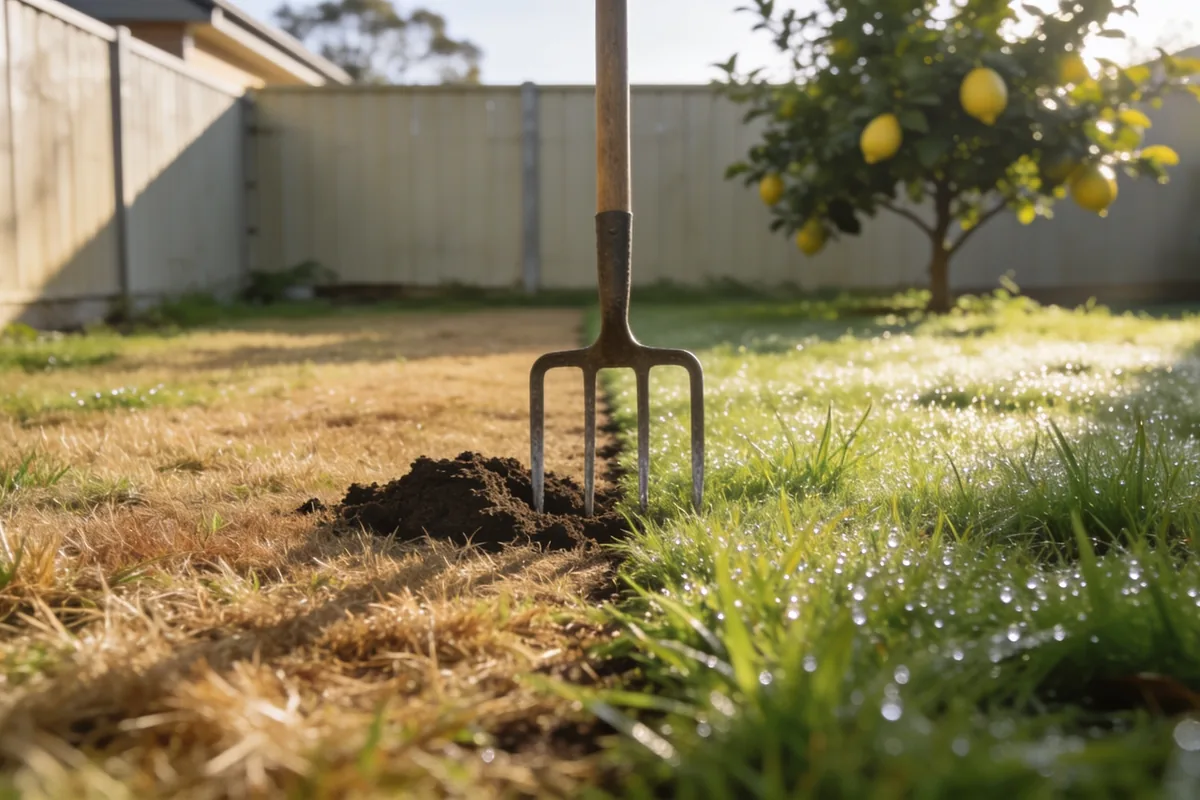
Most of the diagnosis happens before anything is bought. Winter damage is not one condition, and no single purchase fixes all three, so a lawn that is brown in August can be a dormant lawn, a compacted lawn or a dead lawn, and those are three different jobs with three different costs. The first check costs nothing and takes a minute: examine the crown, the base of the leaves, and read the colour. Everything else follows from that reading.
Spring lawn recovery checklist
0 of 9Work top to bottom. The crown test at the top decides whether the rest is worth doing.
The spring order
Recovery takes weeks, not a weekend. If the crown is not white to off-white, the answer is fresh turf, not a treatment.
The crown test, and what each answer means
The crown is where the plant keeps its growing point, so it is the part that says whether there is a plant left to work with. If the crown is white to off-white, the grass is probably still alive, and it can be salvaged with dedication and effort. The test is a five-minute job with a fingernail or a knife at the base of the leaves, and it settles the question the whole checklist depends on.
If the crown is not white, the answer is the hard one. The source is direct on this point: a lawn allowed to die completely will not come back in winter, and fresh turf is the replacement. Watering a dead lawn does not resurrect it, which is why the crown test comes before any purchase, and why the order in the checklist above is not arbitrary. A white crown means the work is justified and the recovery is a matter of weeks; anything else means the money is better spent on turf, and the rest of the list has nothing to offer.
The test also has limits. It reports on the plants in the sample, not on the whole lawn, so it should be run in several spots, including the worst one. A green corner can flatter a lawn that is mostly gone, and a brown patch can hide crowns that are still white, which is why several samples beat one confident glance. It says nothing about why the lawn reached that state, either. That is the soil question underneath it.
Why winter does this
Cold slows growth, which is the dormant lawn and the ordinary case. Wet soil compacts under weight, which is the second case, and the mechanism matters because it explains the recovery order later: in compacted ground, water and air cannot reach the roots, so the grass starves while the surface looks as though it has been watered plenty. Shade and traffic do the rest of the damage between them.
The result is a lawn that can be over-watered and under-fed at the same time. The surface holds moisture, the roots do not get what they need, and the thatch builds up between the two. That is the whole mechanism in a sentence: compaction starves the roots, and the surface hides it. None of that damage is visible from the street, which is why the diagnosis has to go below the surface before the order of work makes sense.
The three cases also explain why the spring work is ordered as it is. Aeration addresses the compaction; the wetting agent addresses water that will not soak in; top dressing addresses the layer between the two. Feeding addresses none of them, which is why it comes last. The order exists because of that mechanism: each step removes an obstacle for the next.
The spring order, and why it is this order
Aeration comes first. It creates small holes so air and water penetrate to the roots, which is the compaction problem addressed at its source, and it is the step that treats the cause rather than the appearance. The source’s specification is holes at least 8 centimetres apart; a pitchfork handles a small area, pronging shoes do the same job as the reader walks, and larger lawns justify hired equipment. The timing for warm-season grasses, which include soft-leaf buffalo, couch, kikuyu and zoysia, is spring, before the summer heat, and the source adds the line that matters for a brown lawn: it is never too late to aerate.
Top dressing comes immediately after aeration or verti-mowing, not weeks later, which is the sequencing most home lawns get wrong. The source’s reason is mechanical rather than aesthetic: the holes are open and the dressing has somewhere to go. Then a quality wetting agent, applied after the dressing, because the source’s own note is that aeration helps manage thatch so wetting agents can penetrate. Then water.
The order is not a preference. Each step opens the way for the one after it: the holes let the dressing in, the dressing and the agent let the water down, and the water finishes the job. Reversed, the same materials sit on the surface and the weekend is spent. That is the sequence in one line: open the soil, dress the soil, wet the soil, then water it. The container on the shelf is not the first step, and on a lawn that has been compacted for years it is nearly the last. The same order applies to a lawn that is only patchy: fewer holes, less dressing, and the same sequence. The crown test decides the case, and the order decides the work.
Where the lawn is beyond saving, the order changes completely. Poor soil is amended or removed and replaced before fresh turf is laid, not after it fails.
Watering, measured rather than scheduled
Watering is where the calendar does the least good and a physical test does the most. The source’s test needs no equipment: tread firmly on the grass, and if it does not spring back, it needs a drink. That reading comes from the plant rather than from a timetable, which is why the test comes before the sprinkler goes on rather than after.
Water in the morning, when there is usually less wind, because the aim is to cut evaporation and get the water down to the roots. The morning run gives the water the best chance to reach the roots before the day’s evaporation starts, which is the only reason the timing is specified. Sprinklers run on the reader’s own watering days, which is a local rule and not something this article can set. It is also the variable that governs everything else in a dry month. The test replaces a schedule with a reading, and the difference matters on a lawn that is recovering, because the water it needs changes as the roots come back.
Water that never reaches the roots is a problem to trace at the source as well, and the site’s guide to stopping a leaky tap covers the other place water disappears on a property.
Mowing as recovery, not maintenance
Mowing during recovery is a cutting decision with two variables, height and frequency, and both follow the variety. For soft-leaf buffalo, the source’s figures are every 7 to 10 days in summer at about 15 to 20 millimetres, which is a higher cut than many lawns receive.
Sharp blades matter more than the height setting. The source goes as far as suggesting a blade change about once a year, because a blunt blade tears grass rather than cutting it, and torn tips are open wounds during the season when the lawn is under pressure. Fewer, higher cuts are the shape the source describes for recovery: mow to the frequency the variety expects, and leave the height where the source puts it.
The limit here is a variety question the article cannot answer from the outside. The mowing height for a specific lawn depends on what is growing in it, and the variety is on the tag, the turf supplier’s record or the original invoice. Mowing is the step where the variety matters most, and the one where a general number is least safe. The source’s figures describe one grass, and they are not a table for all of them.
When it is not the cold at all
Two alternative diagnoses deserve a check before any purchase, because both imitate winter damage and neither responds to the spring order above. Both should be eliminated before the order is followed, because a lawn with either problem will not answer to it.
The first is grubs, which eat the new shoots. Watering does not fix a grub problem, which is the tell: a lawn that stays brown despite moisture may be feeding something else. The second is hydrophobic soil, a known behaviour in sandy ground, where the soil repels the water being applied rather than absorbing it. A wetting agent is the step the order above addresses for that case, and the check is to watch where the water goes when it lands: if it beads and runs, the soil is the problem rather than the grass.
What the article cannot know from outside is which of these applies to a given lawn. That is a sample-and-look question, and the source’s own warning stands over it: where the grass has died completely, watering alone will not bring it back. The limit deserves saying plainly: a photograph cannot show a grub, and a soil that repels water looks the same in a picture as a soil that is dry.
The order that saves the most grass
Recovery takes weeks, not a weekend, and the cheap steps come first. The crown test costs nothing and decides the whole approach. Aeration, top dressing and a wetting agent cost time and modest materials, and they address the compaction that caused the problem. Feeding and heavy watering come last, because a dead lawn does not respond to them and a live one responds better once air and water can reach its roots.
The order is the saving, and it has a check built in at the top. If the crown test comes back white, the rest of the list is worth the work; if it does not, the money belongs in turf rather than in treatments. The cheapest steps are also the earliest ones, which is what the whole order is built on. Run the checklist in sequence, revisit the crown test at the end of spring rather than the end of the week, and the grass that was dormant in August gets its season back.
The list takes a weekend; the results take a season. Everything above is arranged to make the first of those as small as possible. The check at the top is also the one to repeat, at the end of spring, when the answer is either a greener lawn or a clear case for turf.
Sources: Water Corporation – Bring your brown lawn back to life
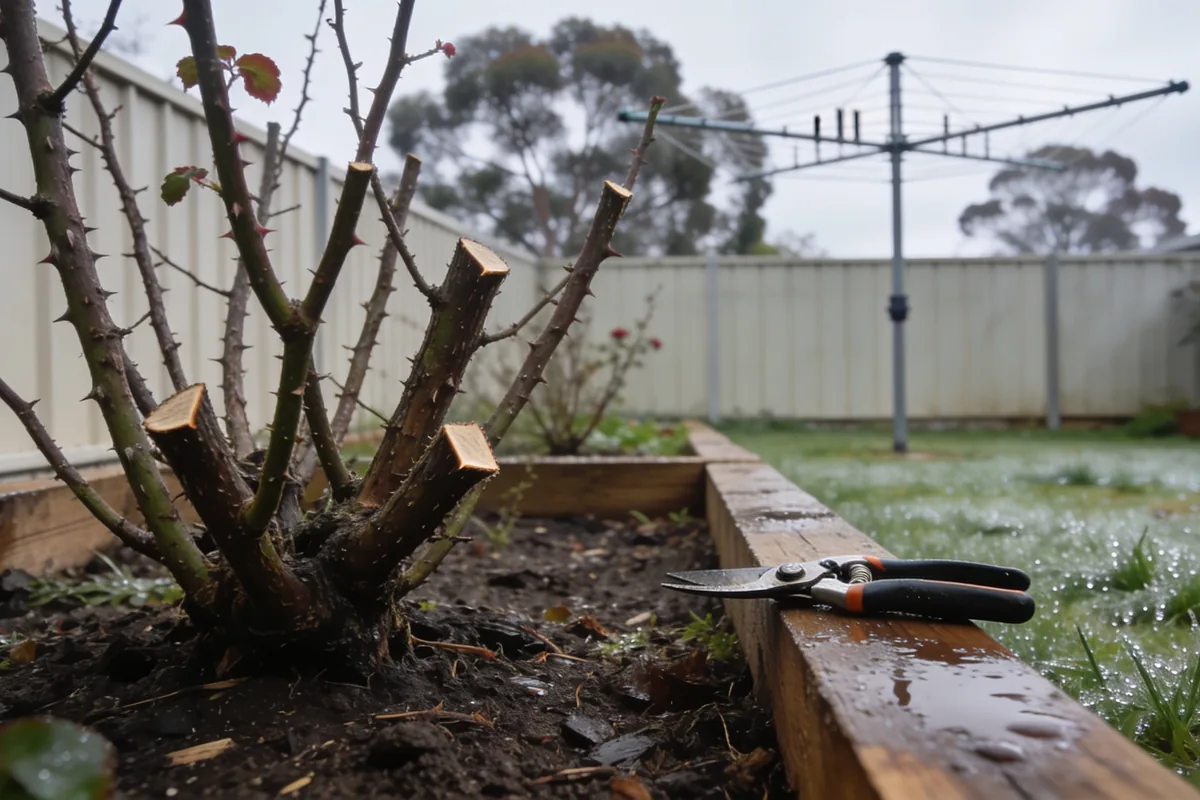
The secateurs are out, the last flowers have gone, and one question is keeping you indoors: is it too early? That worry is a reasonable one, and it deserves a straight answer. Cut a rose back a week before the frosts arrive and the new shoots come away soft; the next cold night takes them, and you spend spring looking at the damage. Here is the reassuring part. The timing is a window rather than a skill, and it is wide enough for most gardens. In most of Australia, the best time to prune roses is June or July. If you live in a really cold area, the advice is to wait until early August, so the frosts do not knock back the new shoots. Most gardens sit comfortably inside that window, and the difference between cutting this weekend and next weekend is far smaller than the difference between cutting now and cutting in May.
It also helps to know which prune you are doing. Roses want attention at least twice a year: a summer dead-heading, where each spent flower is snipped a few centimetres below the bloom, and the harder winter cut that shapes the plant for the season ahead. The June and July question is about the second of those, and it is the one where timing matters. The summer job is forgiving. The winter one is not, because it happens next to the cold. You do not need to be an expert to get this right. You need a pair of sharp secateurs and a week without frost.
One catch sits under all of that, and it is why this question never has a single date. Winter means different weeks in Cairns, in Melbourne and on the Tablelands, and local frost decides your week rather than the month on the calendar. Check the forecast before you check the date.
Why winter is the right season for the hard cut
Winter pruning works because the plant is resting. It is dormant, so the cuts are open but new growth is slow to arrive, and fewer pests and spores are moving about. The frost rule comes from the same place: it is not the cut itself that damages the bush, it is the soft growth a cut encourages too soon, before the cold has finished with your garden. Patience here is not caution for its own sake. It is the whole technique.
The second reason is air. Opening up the centre of the bush so there is more air circulating is a disease measure, not a tidying one. Air moving through the middle, and light reaching the wood, are the point of the exercise, and anything overhead changes how much light gets through. If your roses grow under a patio or a carport, the site’s guide to polycarbonate roofing over a garden is clear about what a cover does and does not change for the plants below it.
There is one more quiet benefit to cutting in winter. With the leaves gone, the frame of the bush is bare, and the shape it will carry into spring is finally visible. That is why this is the cut that sets the structure, and why a few minutes spent looking before the first cut is time well used.
The four cuts that do the work
Four cuts, in this order, do almost everything a winter prune needs to achieve. Work from the top of the bush downwards, and step back between cuts to look at the shape you are making.
- Anything dead, or anything showing dieback, right down to stump level. A stub left below a dead stem is no use to the plant, so take the cut back to sound wood.
- Spindly stems. Follow each one down until it is about the thickness of a biro, and remove it there. These are the stems that will not carry a flower worth waiting for, and they take light and air from the ones that will.
- Anything crossing or crowding the centre. Where two stems rub, keep the one growing outward and take the other, so the middle of the bush opens up and the air can move through it.
- The water shoots, and only lightly. These are the young stems, olive green or pink, and they are where the flowers come from, so they get a tidy rather than a haircut.
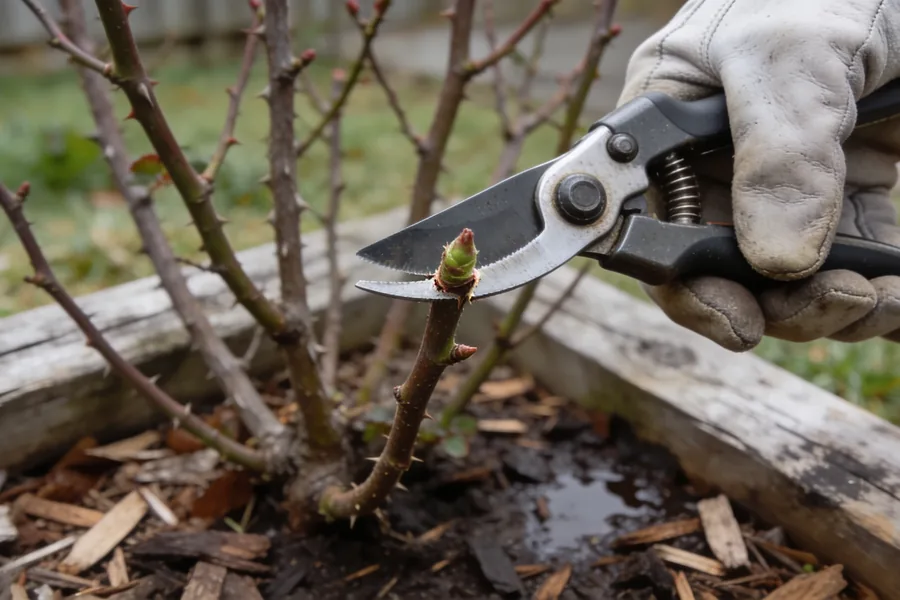
When you make the cut, aim for about a 45 degree angle above an outward facing bud, sloping away from the bud. Rain and dew then run off instead of collecting where the new shoot will form, which is a small thing that helps keep fungal disease away from the wound. The outward-facing part matters for the same reason as the centre cut: the new shoot grows away from the middle of the bush rather than back into it. Work through the four in order, and stop when the middle is open and the strong stems are clear.
How hard to go
How far back you go is a judgement, and the sources offer a scale rather than a rule. If you are a cautious pruner, take about a third off. If you are confident, or the bush has run wild, you can go back by about half. Both are given as sensible choices, so pick the one that matches your confidence and the rose in front of you.
What does not flex is the direction. Cut from the top, and cut to a bud that faces the way you want the new shoot to grow. Every cut is a decision about next season’s shape, which is why stepping back matters more than cutting fast.
There is one more piece of restraint in the sources. Do not rush the winter prune. Let the plant rest first, so the last flowers are enjoyed and the young stems have time to harden off before the cold settles in. A bush pruned in a hurry is a bush that spends winter working instead of sleeping.
And if the two options still feel far apart, the choice comes down to confidence and to the bush in front of you, which is how the source frames it, rather than to a number that has to be exact. A third and a half are both inside the practice. The window matters more than the depth.
The roses that play by different rules
Not every rose in the garden wants the same treatment, and the differences are worth knowing before you start on the row.
- Heritage roses need very little. A light shape, a tip prune and anything dead removed is the whole job, and nothing more is asked of them.
- Ground cover roses can be cut back almost to ground level. They regrow by spring, particularly with fertiliser and mulch through the warmer months.
- Repeat flowering roses are pruned three or four times in a season. The winter prune is the hard one; the others are lighter, and it is the severity that changes, not the technique.
The three or four prunes in a season are not three or four winter prunes. The hard cut happens once; what follows is the light tidying after each flush of flowers, and the bush barely notices it.
The caution from the sources deserves repeating here. In a frost-prone area, leave the pruning until the chances of frost are over. Prune early, and the warm spell that follows can push new growth straight into the next cold night. If the bush has not finished dropping its leaves, it has not finished resting either, so wait.
One more case needs naming, and it does not fit a rule. If your rose flowers on last season’s wood, the winter prune is a different conversation, and it is a question to ask about your own plant rather than something a page can settle. Take a photo of it in flower, ask at a nursery, and prune the rest of the row while you wait for the answer. That is not a gap in the advice, just the limit of what advice can do without seeing the plant.
What to do with the prunings
The prunings go to the bin or the mulch pile. If you have small children at home, sorting the garden waste is one of those jobs they can genuinely take part in, and the site’s piece on recycling ideas for preschoolers turns the sorting into something closer to a game than a chore.
The one thing not to do is feed or water the bush heavily straight after the cut, hoping to push it along. The growth that encourages is soft growth, and soft growth is what the frosts are looking for. Hold the heavy feeding until the cold has passed and the plant is ready to use it. The same restraint applies to water. The instinct after a hard cut is to give the plant something to work with, and the season says otherwise.
Where to make the first cut
Before you start, three checks, and together they take about five minutes.
- Is there a frost forecast in the next week or two? If there is, wait, or start with the roses that sit outside the frost pocket.
- Has the bush lost its leaves? If it is still holding them, it has not finished resting yet.
- Are the secateurs clean and sharp? The job is hard enough without fighting the tools.
Then start where the answer is easiest: the dead wood. The first cut is the one that feels like a decision, and a dead stem is the one cut nobody can get wrong. After that the bush tells you what it needs, and you will wonder why you put it off. And if the forecast turns, nothing is lost by waiting a week. The window is June and July for most gardens and early August for the cold ones, and it will still be open when the frost has gone.
If you are new to roses, the first winter is the one where every cut feels like a risk. Start with the dead wood, take the spindly stems after that, and leave the water shoots alone until you have watched them flower once. The next winter will feel like routine.
If the forecast looks clear and the bush has dropped its leaves, you are ready. Start at the top of the bush, work down, and let the first cut tell you how the rest will go.
Sources: Gardening Australia – Rose Pruning · Heritage Roses in Australia – Rose Pruning


 Healthcare1 year ago
Supported Independent Living Explained: What SIL Covers and Who It Suits
- Food1 year ago
Balance Your Plate, Boost Your Mood: Beginner’s Guide to Eating Well
- Healthcare1 year ago
Oral Health at Every Age: What Changes and What to Watch For
- Healthcare1 year ago
The Allergy You Can’t See: How to Detect and Manage Silent Food Reactions
- Healthcare1 year ago
Occupational Therapy for Children: The Signs It Could Help, and How to Start
- Healthcare1 year ago
Home and Living Support Under the NDIS: What It Funds and How It Fits a Plan
- Business1 year ago
Connections That Count: Why Networking Is Still Crucial for Business Success
- Healthcare1 year ago
When Everyday Tasks Get Hard: What an Occupational Therapist Can Do