Eco Friendly
Eco-Friendly Gift Ideas That People Actually Keep

There’s a particular kind of tiredness that comes from standing in a shop trying to choose a gift that won’t end up in a landfill by February. You want to give something thoughtful, you want it to feel like a gift rather than a lecture, and you’d rather not add to the pile of things people quietly re-gift. The good news is that the whole problem has a shortcut, and it’s not a compromise at all: the eco-friendly gift that people actually keep is simply a gift that gets used. This guide takes the five kinds that pass that test, with the trade-offs stated honestly, and ends with the part everyone forgets, which is the wrapping.
What makes a gift eco-friendly, honestly
Most of the environmental benefit of a gift comes from a single fact: whether it gets used. A perfect item that sits in a cupboard has taken resources, transport and packaging to become clutter, which is the opposite of the intention. A slightly imperfect item that earns a place in someone’s daily routine has done its job for years.
That reframing does most of the work. It means the question is not “is this green enough” but “will this person actually use this”, and it takes the guilt out of the decision, which is the point of the title. The categories below are where the honest answers usually land.
The five kinds of gift that get kept
| Gift type | Example | Why it gets kept |
|---|---|---|
| Reusable items | A beeswax wrap, a good water bottle | It earns a place in a daily routine |
| Handmade | Preserves, a knitted scarf, a framed print | It carries the maker as well as the use |
| Experiences | A class, a membership, a night away | It becomes a memory rather than an object |
| Digital | A book, a course, a subscription | It arrives instantly and takes up no space |
| Secondhand | A vintage find, a restored tool | It is a find rather than a purchase |
Reusable items
The classic of this category is the beeswax wrap, and it is worth knowing what it is actually good for before you buy one for somebody. A wrap is excellent for covering a bowl, wrapping a sandwich or a piece of cheese, and it does that job for a year or more with a rinse between uses. It is not the thing for raw meat, it does not love a hot dishwasher, and it eventually wears out. Give one alongside a note about how it should be cared for, and it will be kept; give one as an unexplained substitute for cling film, and it may confuse.
Handmade
A handmade gift works when the making is the point: preserves from the garden, a loaf of something, a knitted thing made with a specific person in mind. The trade-off is honesty about your skills, because a badly made gift can put the receiver in the awkward position of thanking you for something they will never use. The rule of thumb is to make what you are already good at, in a size and style the person actually lives with.
Experiences
An experience is the category that produces the best memories and the most unused vouchers, and the difference is in the choosing. The gift that gets used is one the person would have done anyway: their regular coffee, the film they were going to see, a class in something they already love. The ones that expire are the grand gestures with a redemption process attached. Where a voucher is involved, check the expiry terms before buying, and give the booking as part of the gift so the first step is already taken.
If the experience leans towards the kitchen, a cooking class is a lovely choice, and it pairs well with a gentler starting point than most cooking advice offers: the beginner's guide to balanced eating is the sort of thing to send along afterwards rather than wrap.
Digital
A digital gift, such as a book, a course or a subscription, has an obvious environmental story: nothing is manufactured and nothing is shipped. The trade-off is that it can feel thin when it arrives as an email, so it needs a little ceremony. Send it with a note about why you chose it, or pair it with something small and physical, and it lands as a gift rather than a transaction. Do check that the person has what they need to use it, because a subscription to a service they cannot access is more frustrating than thoughtful.
Secondhand
A secondhand gift works beautifully when it is clearly a find: the book from the year they were born, the kitchen tool the right vintage, the piece for the collection they already keep. It fails when it feels like a donation with a bow on it. The test is whether you would happily explain where it came from, because if the story is good, the gift is good, and “I found this and thought of you” is one of the nicest sentences a gift can arrive with.
The wrapping nobody keeps
The wrapping is where the good intentions quietly undo themselves, and it is also the easiest part to fix. Paper that is shiny, metallic or glittered cannot be recycled, and the average roll of it becomes waste within seconds of being admired. The alternatives are not a sacrifice.
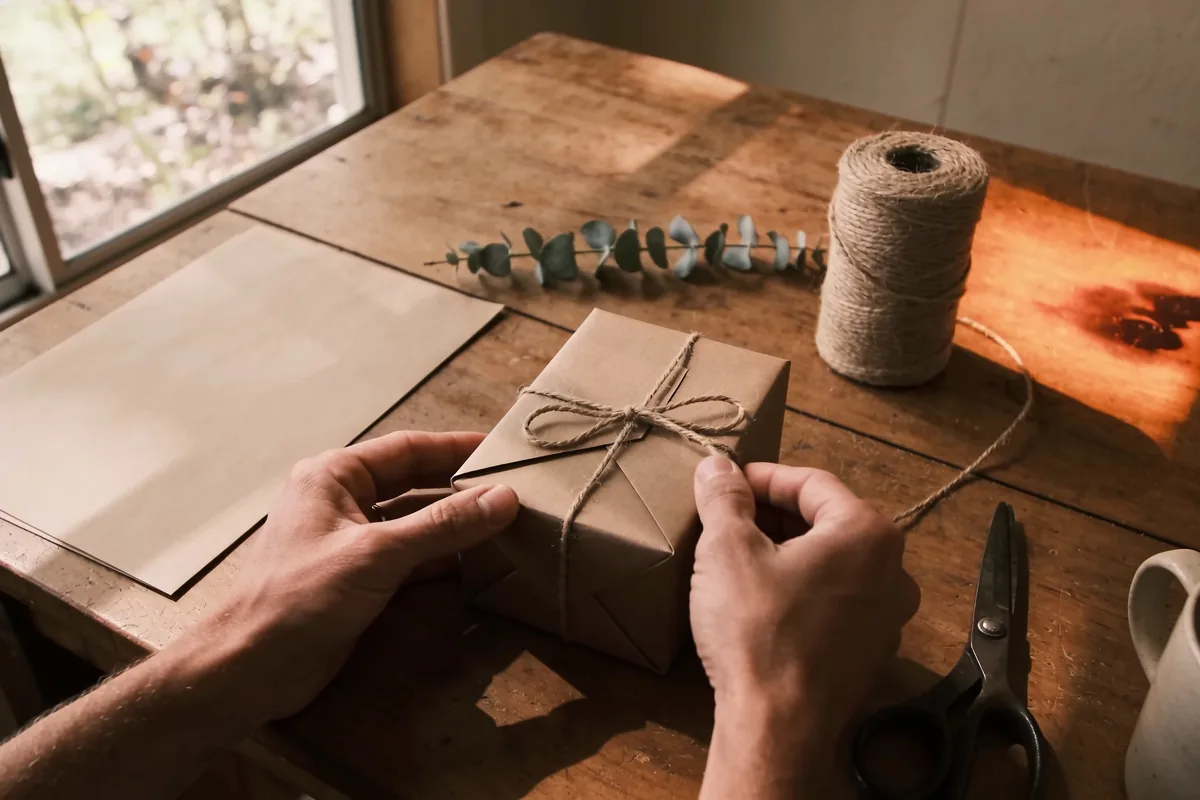
Cloth wraps are the nicest version: fabric squares that fold and tie around a gift and then live in a drawer until the next birthday. A sturdy gift bag that gets passed around the family for years beats a paper one that does not survive the day. Plain recycled paper with twine and a sprig of something from the garden looks better than most printed wrap, and it goes straight into the recycling. And the wrap itself can be part of the gift: a tea towel, a scarf, a tote bag.
One small rule covers the whole section. Choose wrapping that can be reused or recycled, and skip the tape where you can, because that is the bit nobody can do anything with.
The card deserves the same thought, since it is the one part of a gift people almost always keep. A card made from recycled stock, or one that doubles as something else, such as a bookmark or a recipe, does the job better than a glittered square that cannot be recycled. If you write something in it worth keeping, the card has already outlasted most gifts.
When the person has everything
There is always one name on the list who wants nothing, needs less, and would gently re-home anything you bought them. This is where the categories earn their keep, because the answer is almost never a thing.
An experience works when it is chosen around something they already do. A consumable works when it is genuinely good: the coffee they love, the preserves you made, the plant for the garden they actually tend. A gift to a cause they care about works when it is personal to them rather than to you. And the handmade category has a quiet advantage here, because a small thing made with them in mind is not clutter, it is a message, and messages do not need shelf space.
The small step for the tricky name on your list is to choose one of those four and stop looking. The search is what turns a kind impulse into a chore, and the person in question would rather have your time than your research.
A small step to start with
Pick one person on your list and choose their gift from the categories above, asking yourself honestly whether they will use it. Then wrap it in something that does not end up in the bin by lunchtime.
That’s the whole method: gifts that get kept, and wrapping that doesn’t need to be. Less clever than it sounds, and a great deal less wasteful than most of what the shops would happily sell you.

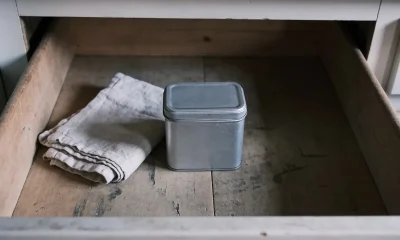





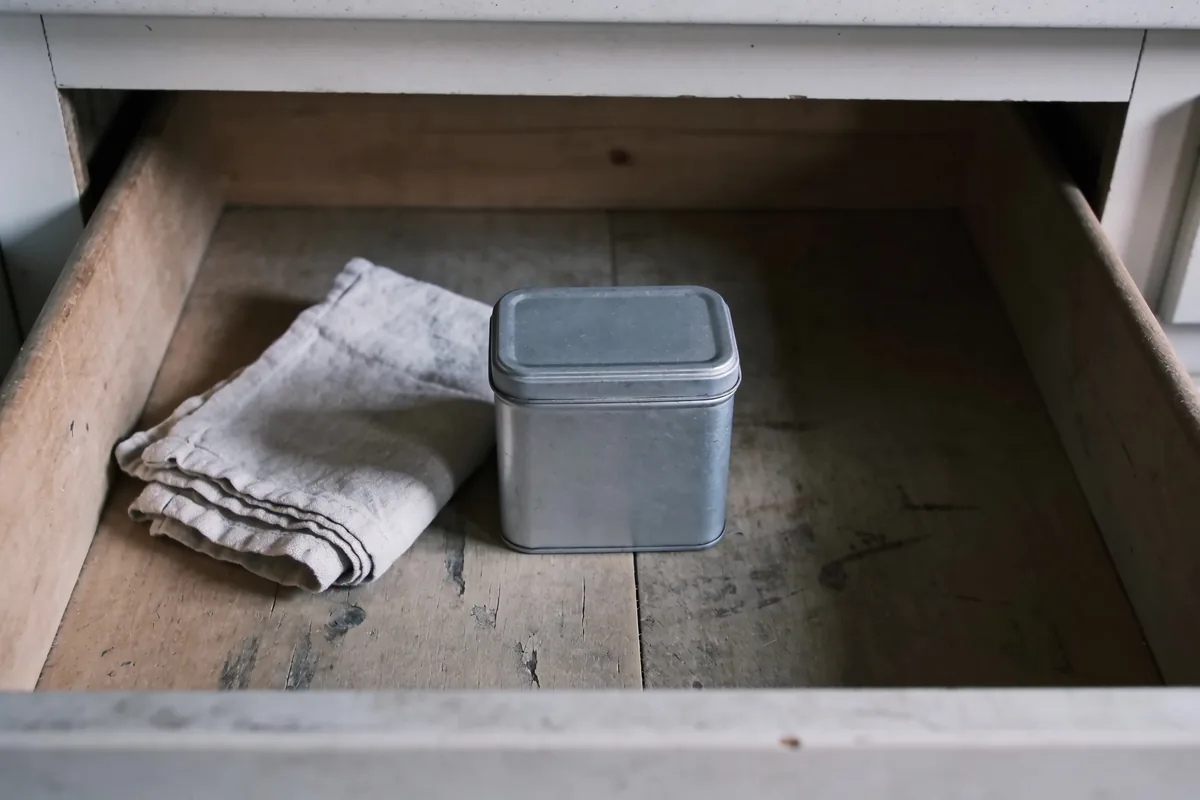
The drawer opens with a rattle. Inside is a tangle of dead batteries in four different sizes, a birthday-candle lighter that has not been used since the last birthday, a spare key for a house nobody lives in any more, and the beginning of a plan that never got finished. Every household in the country has this drawer. Nobody empties it properly, and the reason is not laziness. It is that nobody has ever been told what the next two minutes should look like.
So here it is: tape the terminals, keep them out of the bin, and take them to a drop-off when the jar fills. The rule is the scheme’s, and it is two sentences long: never bin your batteries, and tape the terminals. Everything below is the reasoning, the method and the per-battery check for the drawer in front of you. It is not a job for a special trip or a rare burst of virtue, either. It is a two-minute habit that fits inside a week that is already full. When the drawer finally gives up its last mystery battery, the two minutes are over for another year.
What do I do with this battery?
Answer one question and get the taping instructions for the battery in your hand.
Answer the question and the taping instructions appear here.
Answer the questions and your summary will appear here.
Clear sticky tape only. A taped battery still goes in a jar until your next drop-off, never in the bin.
If the battery is damaged or swollen, do not tape it and do not bin it. Ask the drop-off or the retailer how they want it handed over.
Why the bin cannot have them
The bin is the wrong answer for one physical reason, and the source states it without dressing it up. When used batteries are tossed into general waste or recycling, they create a fire hazard. That is the part that changes behaviour, because the fire does not stay in the bin: batteries are compact, they carry charge until they are flat, and a truck full of waste is not a place where anything can be contained.
The second reason is slower, and it is the one landfill makes worse. In landfill, batteries can leak toxic materials into waterways and ecosystems. That sentence is the whole of the environmental case, and it does not need help from anything stronger. Used batteries do not belong in the waste stream, and the fix is not a disposal problem to solve later. It is a habit to build now.
The scale of the object is the thing to sit with. A battery is a small packet of stored energy, and the waste stream is not built for stored energy; it is built for things that have finished. A flat battery has not finished in the way a bottle or a box has finished, and treating it as rubbish is the mistake rather than a moral failure.
There is a version of the landfill point that sounds like a lecture, and it is not the one this paragraph is making. The point is mechanical: batteries are made to hold energy and materials, and both are better out of the ground than in it. The scheme exists to take them, so the household’s job is only to hand them over properly.
The two halves of the warning also explain the two halves of the method. The bin is refused because of what a battery can do in the waste stream, and the tape exists because of what a battery can do to the batteries around it. Read together, they make the rule small and complete: the bin is never the destination, and the terminals are never left bare.
The tape, by battery type
Tape is the habit that makes the rest safe to handle. The source’s reasoning is mechanical rather than fussy: if battery terminals touch, they can spark and catch fire, so the tape stops the circuit before it can start. Use clear sticky tape, always, and the type of battery decides where it goes.
Regular batteries, which is everything in the drawer from D down to AAAA, have terminals at both ends. Tape both ends. That includes the ones that look flat and dead, because flat is not the same as inert.
Nine-volt batteries are the odd shape. They have two terminals at the same end, sitting side by side, and the instruction is to completely cover all exposed metal. A single strip laid across both terminals does the job.
Button batteries are the small ones, the ones from watches and scales and the little screwdriver that has not worked in years, and they have their terminals on the base. Cover them in clear tape on all sides, because on a battery that small there is no side that is not a terminal.
If you cannot tell what you are holding, the safe answer is to treat it as all of the above: cover every exposed terminal, every side, before it goes in the jar. The bar is not knowing your battery types. The bar is making sure no two bits of metal can touch. The widget above is that rule written as a question, for the moment when the drawer is open and the battery is in your hand.
The tape does two jobs, and both matter. It stops the terminals touching each other, and it stops them touching anything else metal in the jar. One strip of clear tape turns a loose battery into a safe object, and clear is the source’s own instruction rather than a preference, because the terminal stays visible underneath it.
The kit is therefore two items and no more: a roll of clear sticky tape, and a container by the door. Nothing about the method depends on a product, a brand or a special bag, which is the other reason it survives a busy week. If the tape runs out, the jar waits; there is no version of this that needs a trip to a specialist shop.
Handling is otherwise ordinary. A battery comes out of the device, it gets taped, it goes in the jar, and the hands that did the work are the hands that were already there. Nothing about the process needs gloves, a workshop or a special day of the week. Used batteries, taped, stored and handed over: that is the whole list.
One case sits outside the method, and it is the one to ask about rather than improvise. A battery that is damaged or swollen is not a taping job, and it is not a bin job either; the drop-off or the retailer is where the question goes, and their answer is the one to follow.
The bag and the box
The method that survives is a container by the door. A clear jar works, and so does a small box, and the point of putting it where the batteries die is that the trip only happens when the jar fills. Batteries go in taped, one at a time, at the moment they come out of the device. That single change is what separates the intention from the habit, because it removes the drawer entirely: no drawer, no archaeology, no shoebox of mystery batteries from a decade of remotes.
The jar also solves the storage problem. Batteries kept loose in a drawer roll against keys and coins, which is the same contact the tape exists to prevent, so the container is part of the method rather than a tidiness flourish. Clear is better than opaque, because you can see how full it is and whether everything in it is taped.
The jar pairs with a wider habit: what a household brings in and keeps, set against what it throws out. The site’s piece on eco-friendly gift ideas that people actually keep applies that instinct to the things that arrive. The jar by the door is the whole technology.
Where they go
The jar goes to a drop-off, and Australia has a scheme for exactly this. B-cycle is the nation’s official battery stewardship scheme and it runs the national drop-off network, so the destination is a supermarket or retailer drop-off found through the scheme’s own find-a-drop-off tool. That is as specific as this article gets, and that is deliberate: outlets change, and the scheme’s own tool is the only list to trust.
Having the scheme’s name matters for one practical reason: it is the scheme’s rather than any one retailer’s, so the tool stays right even when a particular store changes hands. The scheme’s shape is also what makes the errand small. It is Australia’s official battery stewardship scheme, which means the collection network already exists, and the household’s part is the last step of it.
What happens to the batteries after the counter is the scheme’s work rather than the household’s, and it is not a story this article tells. The collection network is the point that matters here: a jar of taped batteries handed over properly is the whole of the household’s job, and the scheme’s own pages are where the rest of the journey lives.
What the scheme does not need from you is certainty. A jar of taped batteries, carried in on a normal shopping trip, is the whole errand. No booking, no packaging, no ceremony. One trip in the shopping bag also means the jar empties on an ordinary Saturday rather than on a dedicated outing, which is the difference between a habit and a project.
Before the bin
Skip the guilt. The drawer is not a moral failure, it is a missing habit, and the habit is two minutes long.
Skip the shoebox of mystery batteries. If you cannot tell the type, tape every exposed terminal, because coverage beats identification every time. And skip the idea that this is a hard job, because it is not: it is clear tape, a jar, and one trip with the shopping. The bin was never the problem. It was just the easiest thing to do, and the jar by the door is easier.
Skip the special trip, too. A scheme that needed a dedicated journey would not have put its drop-offs in supermarkets, and the jar is designed to empty while you are buying milk. And if the drawer still holds a pair of mystery batteries after all of this, tape them, add them to the jar, and let the next shopping trip finish the job. The drawer does not have to be emptied today. It has to stop being the place where batteries go to be forgotten, and the jar by the door is what replaces it.
Sources: B-cycle – Battery safety (Australia’s official battery stewardship scheme)

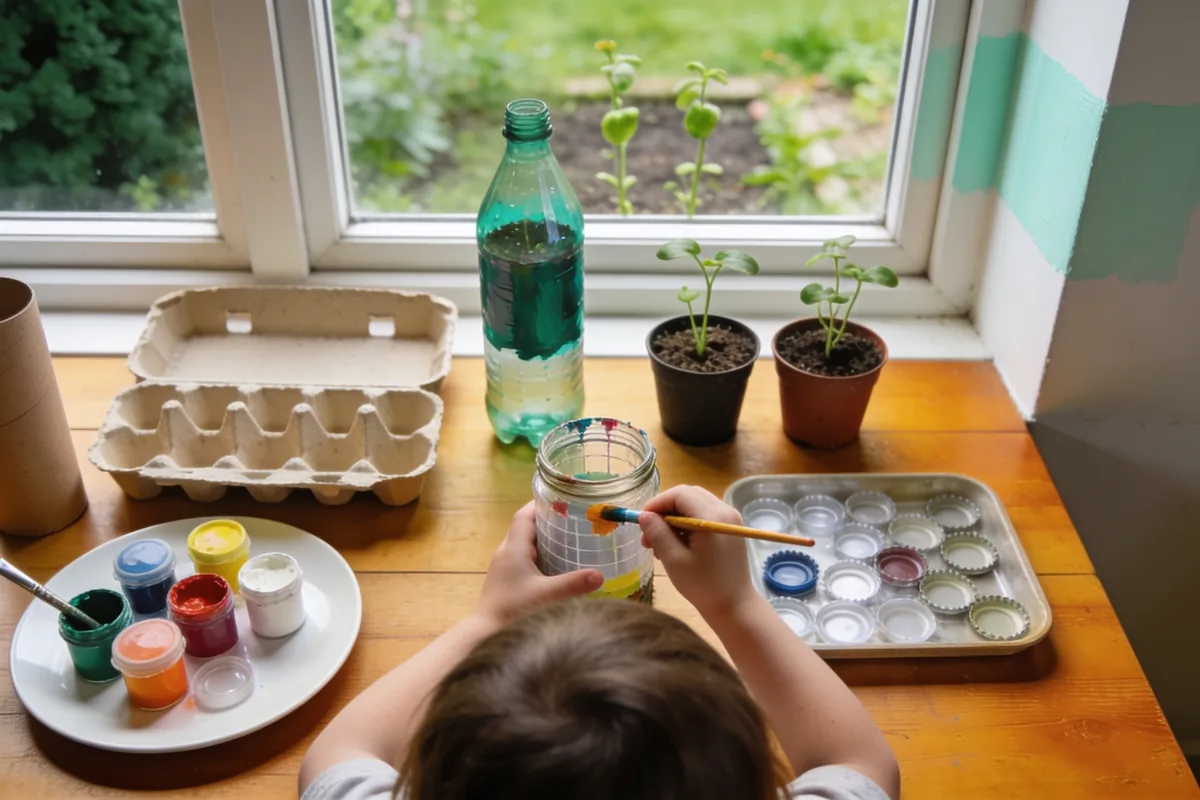
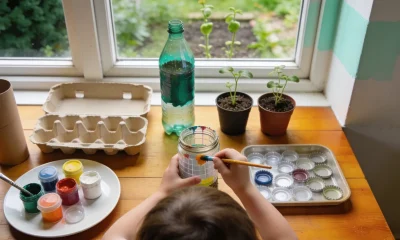
Teaching a preschooler about recycling works better through the hands than through the explanation. The activities below turn household waste into planters, instruments, games and art, and each of them teaches the same idea without saying it aloud: an object that looks finished can have another purpose. Ten activities are collected here, with what to gather beforehand, which steps belong to the adult, and how long each one takes, because a project that wants an hour will lose a preschooler in ten minutes.
Why recycling matters for preschoolers
The case is practical rather than sentimental. Early exposure to reuse and recycling helps a child to understand environmental responsibility in concrete terms, to see that everyday waste can be turned into something useful, and to develop fine motor skills and coordination through the crafting itself. Problem-solving arrives with the question of what an object could become, and group projects add teamwork and turn-taking on top. None of it requires a lecture, which is the part that matters at this age.
What to collect before you start
The activities draw on a small stock of clean, safe materials, and collecting them over a week or two is part of the preparation.
- Plastic bottles with their caps, washed and dried.
- Egg cartons, cardboard rather than foam where possible.
- Toilet rolls and paper towel tubes.
- Tin cans with the labels removed, washed, with any sharp edges taped.
- Milk or juice cartons, washed and dried.
- Cardboard boxes, including one larger box for the theatre.
- Scrap paper, old magazines and cardboard for collage.
- Non-toxic paint, glue, sticky tape, string and child-safe scissors.
- For the growing activities: potting mix, fast-growing seeds such as basil or beans, and birdseed.
- A set of small bins or trays for the sorting activities.
The one rule that applies to all of it: wash and dry everything before it goes into a child’s hands, and throw away any container that still smells of what it held.
The ten activities
1. DIY bottle planters
A plastic bottle becomes a planter in three steps. An adult cuts the bottle in half, the child decorates the outside with non-toxic paint, stickers or tape, and together you fill it with potting mix and plant a fast-growing seed such as basil, sunflower or beans. Allow half an hour plus planting time, and then weeks of watching. Safety note: the cut edge of the bottle is sharp, so run a strip of tape around it before the child handles it. Where the planter will grow something edible, use a food-grade container rather than an unknown plastic.
2. Egg carton crafts
Egg cartons are ideal for small hands. The child can paint them into caterpillars, insects or flowers, glue sections together into structures, or use them for counting and sorting games. Allow twenty to thirty minutes. Adult steps: cutting the carton sections apart if a clean edge is needed. The activity doubles as early numeracy practice, which is worth knowing when the craft interest is shorter than the counting interest.
3. Toilet roll binoculars
Two empty toilet rolls taped side by side become binoculars in minutes. The child decorates them with coloured paper, markers or stickers, then takes them outside to explore the garden or the park. Allow fifteen minutes plus the walk. Adult steps: the taping, if the child cannot manage the tape. It is the simplest activity on the list and one of the most reliably repeated.
4. Recycled paper collage
Old magazines, newspapers and scrap paper are torn or cut into shapes and glued onto cardboard to make a collage. The child chooses the colours, textures and patterns; the adult handles any cutting that needs sharp scissors. Allow twenty to thirty minutes, longer for a child who settles into it. The tearing is good for small hands, and the activity introduces the idea that discarded material still has value.
5. Tin can drums
Clean tin cans, decorated with stickers, paint or tape, become drums played with wooden spoons. Allow twenty minutes for decorating and as long as the household can bear for the playing. The safety rule is the important part: an adult must check every can for sharp edges and tape or file them before the child touches it, and any can with a damaged rim should go back to recycling rather than into the toy box. The activity carries rhythm and sensory play alongside the recycling lesson.
6. Bottle cap sorting game
Caps of different colours and sizes are gathered and sorted into trays or small bins by colour, size or material, then counted. Allow fifteen to twenty minutes. The child can do the whole activity unaided in most cases, which makes it a good one to set up while something else is being prepared. It reinforces fine motor skills and early maths, and it is the activity that most naturally leads into the household’s actual recycling routine.
7. Recycled puppet theatre
A cardboard box becomes a stage. An adult cuts the window for the stage area, the child decorates the outside, and the puppets are made from socks, paper or fabric scraps before the performances begin. Allow an hour across a wet afternoon, and expect the performance to last longer than the construction. Adult steps: the cutting, and any hot gluing.
8. Milk carton bird feeder
A clean milk carton is cut with openings, filled with birdseed and hung where birds can reach it and cats cannot. Allow twenty minutes plus the watching, which is the real activity. Adult steps: the cutting, the cord for hanging, and checking that the carton is clean and food-safe for the purpose. Where the container’s history is uncertain, line it or use a carton that held only milk. The feeder teaches the connection between reuse and caring for wildlife.
9. Plastic lid art
Lids from bottles and jars are arranged into mosaics and patterns on cardboard and glued down. Allow twenty to thirty minutes. The child does the arranging and the gluing with supervision; the adult checks that no lid is small enough to be a choking hazard for the age group in the room. The finished piece is tactile and bright, and the activity is a good use for the lids that every household accumulates.
10. Recycling sorting station
The long-term project: separate bins for paper, plastic and metal, and a daily routine in which the child sorts the household’s recyclables and says why each item goes where it goes. It takes minutes a day and lasts as long as the household keeps it up. The adult’s role is to set up the bins at child height, to keep the labels clear, and to accept that the first weeks will need checking. It is the activity that turns the other nine into a habit.
The safety rules that cover all ten
The same short list protects every activity on the page. An adult does the cutting, the drilling and the hot gluing, always. Sharp edges on tins and cut bottles are taped or filed before a child handles them. Small parts, including bottle caps, are a choking risk and belong in supervised activities only. Paints, glues and markers should be non-toxic and age-appropriate. And for anything that will hold food or feed wildlife, the container must be food-grade: not every plastic or lined tin is safe for growing herbs or holding birdseed, so use containers whose original contents were food, and wash them thoroughly.
Tips for teaching recycling to preschoolers
Five habits do most of the work. Make it fun, with games and songs alongside the craft. Lead by example, because consistency at home teaches more than any explanation. Use positive reinforcement and praise the effort rather than correcting the mistakes. Keep the activities simple and short, because attention spans at this age are measured in minutes. And encourage curiosity, asking what else the object could become, which is the question the whole approach is built on.
Questions parents ask
What are the best recycling projects for preschoolers?
The simplest ones repeat best: bottle planters, egg carton crafts, toilet roll binoculars and the puppet theatre. Each uses materials most households already have, and each can be finished in one sitting.
How can a preschooler learn about recycling at home?
A small sorting station and a daily routine teach more than any single project. Craft activities add the fun, and involving the child in the household’s actual sorting makes the habit real.
Are recycled crafts safe for preschoolers?
They are safe with preparation: clean containers, taped edges, non-toxic materials, no small loose parts, and an adult for every cutting or gluing step.
Why start so young?
Because the habits formed early are the ones that last, and because the skills the activities build, from fine motor control to problem-solving, are the same skills the early years are for.
Do these activities teach anything beyond recycling?
They build fine motor skills, early numeracy through sorting and counting, creativity, and cooperation when several children work on one project.
Start with one activity
The temptation is to prepare for all ten, which is how craft plans end up as a cupboard of good intentions. Choose one activity for this week, gather the materials for that one, and let the child lead the rest. When the planters have been made and the seeds are in, the eco-friendly gift ideas are a natural next step for a household that has started making things rather than buying them.


 Healthcare1 year ago
Supported Independent Living Explained: What SIL Covers and Who It Suits
- Food1 year ago
Balance Your Plate, Boost Your Mood: Beginner’s Guide to Eating Well
- Healthcare1 year ago
Oral Health at Every Age: What Changes and What to Watch For
- Healthcare1 year ago
The Allergy You Can’t See: How to Detect and Manage Silent Food Reactions
- Healthcare1 year ago
Occupational Therapy for Children: The Signs It Could Help, and How to Start
- Business1 year ago
Connections That Count: Why Networking Is Still Crucial for Business Success
- Healthcare1 year ago
Home and Living Support Under the NDIS: What It Funds and How It Fits a Plan
- Healthcare1 year ago
Tired of Plantar Fasciitis Pain? Shockwave Therapy Could Help You Get Back on Your Feet