Science & Nature
Why Jacarandas Turn Purple in Late Spring, and Why the Footpaths Get Slippery

For a few weeks each late spring, streets in parts of eastern Australia turn purple, and the question that follows is why some years seem so much stronger than others. Residents of a jacaranda street tend to remember a particular spring as the good one, when the canopy was dense and the flowering ran long, and another as thin. Brisbane is one of the cities where the bloom is a reason to visit in its own right, and anyone planning to see it there could fold it into a few days in Brisbane.
The difference between years is not imagined, and there is evidence about it. A citizen-science study published through the Atlas of Living Australia examined thousands of recorded jacaranda sightings and found a relationship between flowering and the weather in the months before. What that evidence cannot do is name a single cause, and the distinction matters for anyone trying to read the season. This article sets out what the tree is, why it flowers when it does, what the study found, why the tree is now treated as a weed in parts of Australia, and the practical matter of the flowers once they fall.
What the tree is
The species is Jacaranda mimosifolia. It is native to South America, not Australia, and belongs to the family Bignoniaceae. According to The Conversation, it was planted widely because it is hardy when young and copes with a broad range of soils and climates, although it is a little sensitive to frost.
Brisbane City Council’s Weeds of Brisbane profile describes it as deciduous or evergreen, growing to between 5 and 15 metres. That range is wide, and it reflects the variety of conditions in which the tree is grown. A street tree in a harsh, exposed position and a park specimen with room and water are unlikely to look alike, which is worth remembering when comparing one tree with another.
The check here is a simple one: before comparing two trees, note how much room, sun and water each has, because a 5 metre tree and a 15 metre tree of the same species are not a fair comparison of the season.
Why late spring
Timing follows the tree’s annual cycle. Weeds of Brisbane describes the flowers appearing in spring, after the tree has dropped its leaves over winter, in most years. The purple therefore tends to arrive on branches that have lost much of their foliage, which helps explain why a street in bloom reads as purple rather than green.
The sequence sits inside the wider turn of the seasons. The year passes the shortest day in June, the tree sheds leaves through winter, and the flowers follow in spring. The sources place flowering in that sequence; they do not tie it to a fixed date.
There is a limit to stating this more precisely. The sources describe when the tree flowers and the conditions associated with a stronger bloom. They do not identify one trigger that switches flowering on, and this article does not claim one. For the same reason it gives no bloom dates by city: late spring is as precise as the evidence allows.
Why some years are better
The most useful evidence comes from that citizen-science study, by Garcia-Rojas, Keatley and Roslan, published in 2023 and presented by the Atlas of Living Australia. The researchers analysed 11,578 recorded sightings of jacarandas from 2009 to 2019, drawn from observations submitted by the public, and compared flowering with weather conditions.
Their finding has two parts, and both need to be stated together.
| Conditions | Association with flowering |
|---|---|
| Warm and dry | More intense and longer flowering |
| Too hot and too dry | The relationship reverses: flowering is weaker |
The first part explains the impression of a good year. A warm, dry run of weather was associated with a denser and longer bloom. The second part is the qualification that is easily lost: beyond a point, heat and dryness worked against the tree. The relationship is a curve, not a straight line in which warmer is always better.
An illustration shows how the curve might look from a single footpath. The three springs below are invented for the purpose; they are not records from the study.
- Spring A follows a mild, wet winter. On the study’s pattern, a less intense and shorter bloom would not be surprising.
- Spring B follows a warm, dry run of months. This is the combination the study associates with denser, longer flowering, and it is the spring residents are likely to remember as the good one.
- Spring C follows a run of months that is hotter and drier again. Here the study’s pattern turns over, and a weaker bloom would be consistent with it, even though the weather was “more” of what helped in Spring B.
The point of the illustration is that Spring C is the one most likely to be misread. A resident expecting a record bloom after an unusually hot, dry year could be disappointed, and the study suggests why. It does not say how hot is too hot for a given street, and this article cannot either.
The study drew a projected implication from this. On its reading, the east coast may see short-term success under a warming climate, while conditions in Perth, which is already warm and dry, may become harder for the tree. That is the researchers’ projection, attributed to them, and not a forecast this article can extend.
It is also worth naming what the data excludes. Citizen-science records reflect where people happened to look and chose to submit a sighting, so they record the trees people saw, not every tree. The study measures patterns across those records. It does not establish what happens inside any single tree.
The check a reader can run is to compare the strength of this year’s bloom on a familiar street with the warmth and dryness of the preceding months, bearing in mind that the relationship turns over at the extremes.
The weed question
The tree’s popularity has a cost that is now formally recognised. Weeds of Brisbane states that the jacaranda is regarded as an environmental weed in New South Wales and Queensland. It was first recorded as naturalised in Queensland in 1987. It can form thickets of seedlings beneath planted trees and spread into woodlands and along creek banks.
In Brisbane, the council lists it as Council Pest Vegetation under its Natural Asset Local Law. Anyone in the city considering planting one, or dealing with seedlings, should read the council’s own profile for what that listing means in practice.
The weed status gives a council good reason to think twice before planting more, although the profile does not say which councils, if any, have stopped. The species that made a street famous can also escape into bushland, and the two facts sit together without contradiction.
The check: before planting a jacaranda, look up its status with the local council, which is the body that decides how the species is treated in that area.
The mess, and the slip
The flowers do not stay on the tree. Once they fall, they collect on paving, driveways, gutters and the roofs and bonnets of parked cars, and residents beneath a mature tree will be familiar with the volume involved.
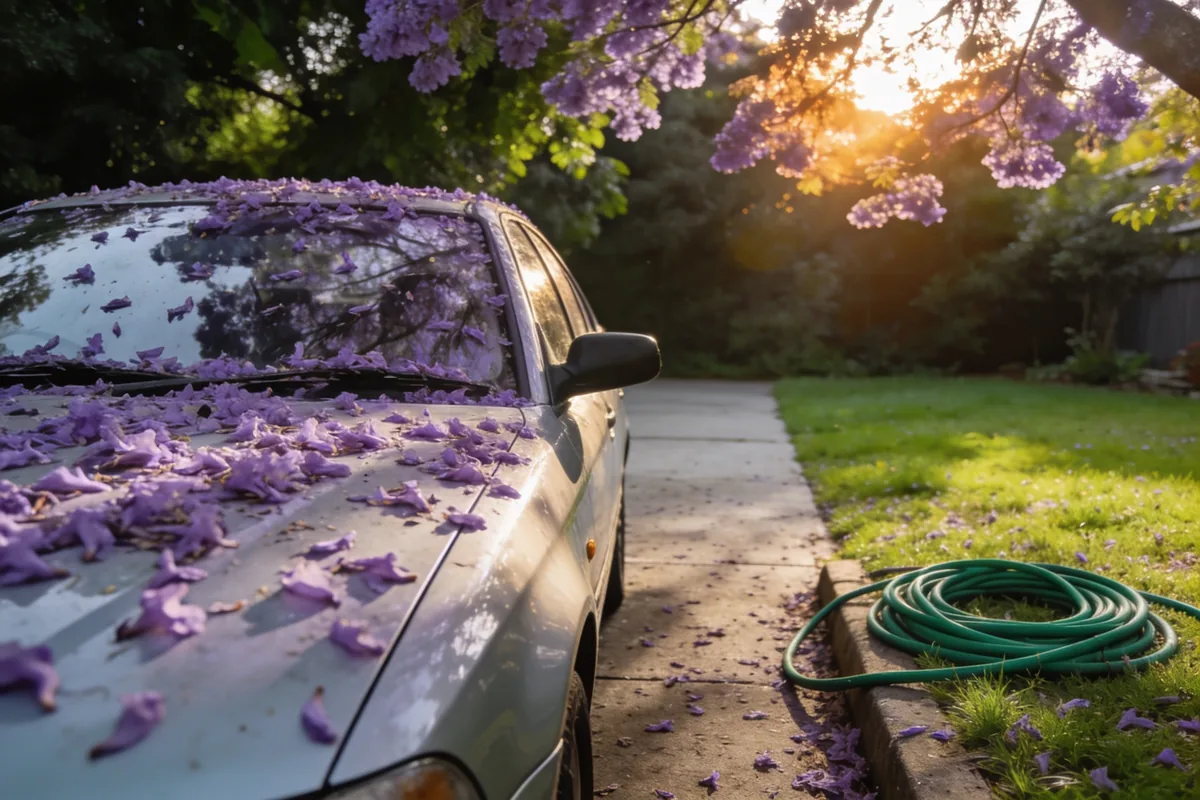

Fallen flowers on hard surfaces can make footing less certain, and a carpet of them on a footpath or a set of steps calls for some care. That is general observation, not a measured finding, and it is offered as such. The practical response is about placement. A jacaranda over lawn or garden beds drops its flowers where they matter little; one planted over a path, a driveway or a carport drops them where people walk and park.
The check for anyone choosing a planting position is to stand where the tree would go and note what lies beneath the full spread of its canopy.
Who visits the flowers
The bloom is not only for people. According to The Conversation, the flowers are visited by some birds and insects, including honeyeaters and honey bees. A tree in full flower is worth watching for a few minutes on a still morning, when that traffic is easiest to see.
The source names the visitors; it does not say how many, at what hour, or how much they depend on the tree. A reader watching one tree on one morning is therefore collecting an observation, not a measurement, which is still worth doing. The check: watch the same tree for five minutes on two or three mornings during the bloom, and note whether birds, bees or both are present.
Questions residents ask
Is the mess as bad as people say? The volume of fallen flowers under a mature tree is considerable, and residents who live beneath one will confirm it. Whether it is a problem depends almost entirely on what lies underneath. Over lawn it is a purple carpet; over a driveway it is a job.
Does a weak bloom mean the tree is unwell? Not necessarily, and this is where the limits of the evidence matter. The study links flowering strength to the weather of the preceding months across thousands of records. It cannot diagnose a single tree, and neither can this article. A thin year after very hot, dry months may simply be the curve at work; a tree in persistent decline is a question for an arborist.
Can I plant one in Brisbane? The tree is listed by Brisbane City Council as Council Pest Vegetation under its Natural Asset Local Law. What that listing means for a particular yard is set out in the council’s own profile, and that is the document to read before buying a seedling.
Why do two trees on the same street flower differently? Room, sun and water vary from one position to the next, and the species ranges from 5 to 15 metres. Two trees of the same species in different conditions are, in effect, two different experiments.
The check: before drawing a conclusion from any one tree, find a second on the same street and compare them.
Reading this year’s bloom
The evidence supports a modest and useful habit. The study links stronger flowering with warm, dry conditions up to a limit, and the tree flowers in late spring after its winter leaf drop. Neither fact gives a date or a single cause, but together they give a reader something to observe.
The check is this. Note the date on which the first tree on a familiar street comes into flower each year, and alongside it, a line on the winter and spring just gone: warm or cool, wet or dry. Over a few years, that record shows how the local trees respond to the season, in a way no general statement can. It is the same method the citizen scientists used, applied to a single street.
Sources: Jacaranda flowering and climate, Atlas of Living Australia Labs (https://labs.ala.org.au/research/highlights/2023_jacarandas/index.html); Jacaranda, Weeds of Brisbane, Brisbane City Council (https://weeds.brisbane.qld.gov.au/weeds/jacaranda); Why there’s a lot more to love about jacarandas than just their purple flowers, The Conversation (https://theconversation.edu.au/why-theres-a-lot-more-to-love-about-jacarandas-than-just-their-purple-flowers-150851)