Pets & Animals
Do Dogs Feel the Cold? What to Watch, and When a Coat Helps

Two questions get asked in the same breath, and they are not the same question. The first is whether a dog can catch a cold, meaning the human illness. The second is whether the dog in front of you is cold right now. Only the second one has an answer a reader can act on today, and it is not answered by a temperature.
No single number decides it either. The sources give no threshold, and that is not an omission to work around: what decides the question is heat loss, shelter and body condition, and those are read from the dog rather than from a thermometer. The check is a sign list, and it is the first thing in this article for that reason.
What this article will not do is name a temperature. A single number would be wrong anyway, because a husky and a greyhound in the same yard are living in two different winters. The order that works is signs first, then shelter, then the coat.
The signs, plainly
Shivering is the sign most owners know, and the source’s framing matters: shivering is a heat-maintenance mechanism, and maintaining heat uses energy. That has a practical consequence. A dog in a chilly environment may need more calories than the same dog needs in summer, and a dog fed exactly as it was in January may lose weight across a cold snap.
Weight is therefore the second sign, and it is slower than the first. A dog that looks leaner in August, or whose ribs are easier to feel than they were, is a dog whose feeding deserves a conversation with a vet. That conversation belongs to a vet, because the right amount depends on the dog, the coat and the conditions, and none of those can be judged from outside.
The third sign is a set of hard behaviours: a dog that tucks its paws, curls tightly, seeks out the warmest corner it can find, or refuses to settle is telling you the same thing the shiver tells you. None of these signs is a scale, and that is deliberate. The signs are the scale.
The check is a two-minute one, and it is best done at the coldest part of the day rather than at noon. Watch the dog, not the forecast: the shiver, the tuck, the curl and the refusal to settle are all readable from the doorway, and none of them requires equipment.
What being cold costs a dog
The cost is energy first. Heat is lost from the body, the body spends energy replacing it, and the spending comes out of the same budget that covers everything else the dog does. Cold is not an emergency at that stage. It is a drain, and it is the reason a chilly dog can lose condition while eating normally.
Water is the part most owners forget, because thirst looks like a summer problem. Dehydration happens in winter too, and the source’s instruction is plain: fresh water available at all times, and never a reliance on snow as a substitute. A dog that drinks less because the bowl is cold, or because the water has frozen over, is a dog being set up for a problem that has nothing to do with temperature.
The hard signs are the ones that need first aid rather than adjustment. Watch for lameness, and for cracked or bleeding paws, in cold weather. Those need immediate first aid, and they are the point at which this stops being a comfort question.
For the reader who wants a number: a dog’s cold tolerance depends on the coat, the body condition, the age, the shelter and the wind, and a vet is the person who can weigh those for your dog. What this article can do is tell you what to watch, and the watch list is short.
Shelter, in the order that matters
The shelter order starts with the source’s own sentence, and it is meant literally: if it is too cold for you to be outside, it is probably too cold for your pet. In severe weather, the instruction that follows is to keep pets indoors, where they are protected from the elements. Indoors is the first answer, not the last resort.
For the dog that sleeps outside, the order continues with the specifics that make outdoor sleeping defensible. Shelter from rain, warmth from frost, and bedding that is off the ground. Pillows or old towels under the bedding are the source’s own answer to ground chill, which is the loss path owners forget, because it works through the floor rather than through the air. Extra blankets matter, and they need changing so they stay dry: a damp blanket is worse than a thin one.
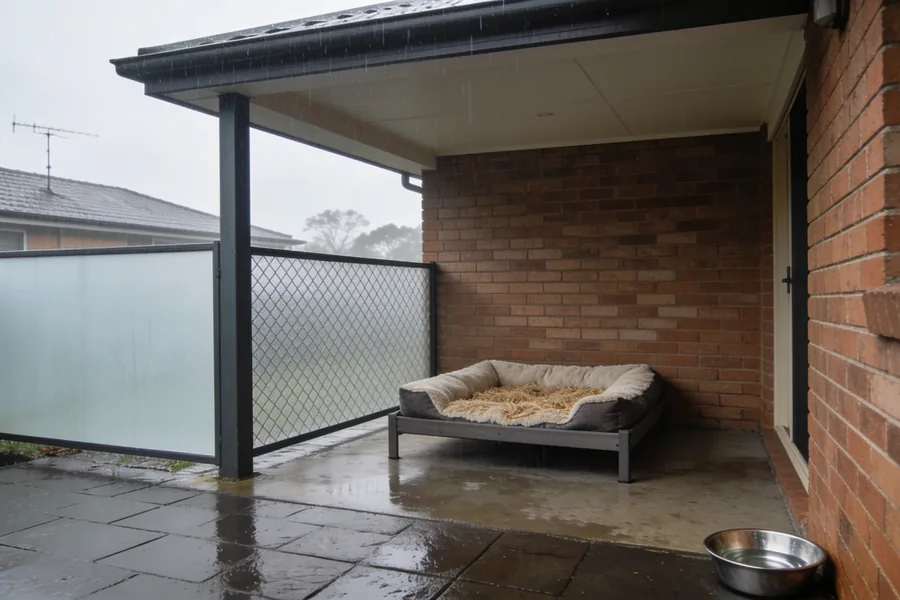

The source also suggests bringing the bed inside during a cold snap, which is a reasonable middle position for a dog that normally sleeps out. And the order ends with bedding maintenance that pays off all winter: keeping the coat a little longer and brushing it regularly, because a matted coat insulates poorly and traps moisture against the skin.
Two checks keep the shelter working through a cold week. The first is the underside check: lift the blanket and feel the bedding underneath it, because ground chill works upwards and a blanket over a damp base is a cold bed wearing a warm hat. The second is the water, morning and evening, because a bowl that has frozen overnight is a water problem wearing a weather costume, and fresh water is the source’s own instruction for the whole season.
The order matters because the fixes get easier as you go, and the first two cost almost nothing. Bedding that is dry and off the ground, a bed moved out of the draught, water kept fresh: none of that needs a purchase, and together they cover most of what a cold snap asks.
The coat question, with the fit test
A coat is not a default. It is a piece of equipment with a fit problem, and the source’s own warning is the reason this section exists: a poorly fitting coat may stop an animal from walking properly, seeing clearly or even using the bathroom. A coat that fails any of those three tests is not a coat that is helping.
The fit test is a short walkthrough, and it is done in this order.
First, put the coat on indoors and let the dog wear it around the house for a few minutes. This is where a bad fit announces itself: scratching, freezing in place, trying to rub the coat off against the furniture. A dog that does any of those things has not accepted the coat, and rushing outside will not change its mind.
Second, check the openings. Look at the neck, the leg straps and the head opening while the dog stands still. The eyes should be clear, the legs should be free, and nothing should be riding up or twisting. If any part of the coat is over the face or catching the legs, stop here and try a different size, because everything after this step depends on the dog being able to see and move.
Third, walk it. Take the dog outside on the normal route for ten minutes and watch the movement rather than the coat. The gait should be the same as it is without the coat. A dog that walks stiffly, holds its head low, or refuses to move past the driveway is telling you the fit is wrong, and the answer is a different size or no coat at all.
Fourth, the toilet test, which is the one owners skip because it is inconvenient to schedule. A coat that interferes with a toilet stop fails, and it fails on every walk until it is fixed. Watch one full walk before deciding the coat works.
For a short-coated dog in a cold snap or a wet wind, a well-fitting coat earns its place. For a double-coated breed that is bred for the cold, the answer is often that the coat is for the owner’s comfort rather than the dog’s.
Consent is the other half, and the source is direct about it: do not push an animal into wearing anything that upsets them. Some dogs accept a coat in minutes. Others will never accept one, and that is an answer, not a training failure. The same test applies to socks, which help some dogs and distress others, and to booties, which are for the dog whose paws are the problem, and only if it will walk in them.
The coat test is also a test of the owner. If the coat is being worn for a photograph, the dog will tell you; if it is being worn for a dawn walk in the rain, that is what it is for. The source’s line about not pushing an animal into anything that upsets them is the whole of the rule.
The hazards that are not the cold
Three cold-weather hazards have nothing to do with the temperature outside and everything to do with where the heat is.
The first is the car. A car behaves like a refrigerator in cold weather, and the source’s own warning is that a pet’s core temperature can drop several degrees quickly. A pet is never left in a car in cold weather, for the same reason it is never left in one in summer: the vehicle does not hold a comfortable temperature, it holds the outside one.
The second is under the car. Cats in particular may seek warmth under vehicles, so the check before starting is to look underneath and bang on the bonnet. That is a ten-second habit with a hard reason behind it.
The third is the heat itself. Keep pets away from fires and heat sources, which the source names as its key safety precaution. And avoid hot water bottles or electric blankets in a pet’s bed, because some pets chew the wires or the bottle, which can harm them. The safest heater is the one the pet cannot reach.
The same cold snap is working on the house at the same time, and the site’s guide to what to do if your pipes freeze overnight covers that side of the same morning.
None of the three hazards is about the weather itself, which is why they survive the mild days. A cold car is dangerous on a morning the forecast calls ordinary, and a heater is a hazard whenever it is on.
When a coat earns its place
A coat earns its place when the dog is short of coat, the weather has teeth, and the dog walks normally in it. It loses that place the moment the fit interferes with walking, seeing or toileting, or the moment the dog says no.
That is the deciding test, and it is a five-minute one. Bring the bed in off the ground or lift it onto a pallet, change the bedding for something dry, check the water bowl has fresh water in it, move the bed away from the heater, and try the coat on the next cold morning with a walk around the block. A dog that is suddenly inside more also needs more to do, and the site’s piece on why busy dogs do better with treat-dispensing toys is the practical answer to the winter-indoors problem. Everything else in this article is a check you can run at any time, and the signs are the ones to know by heart. If one of the signs from the top of this article is showing tonight, tonight is the night for the list; if not, it is still five minutes well spent before the cold week arrives.
Sources: RSPCA New South Wales – Keep your pets warm this winter · RSPCA South Australia – Cold weather tips for pets