Personal Finance
Does Buy Now, Pay Later Hurt Your Credit Score?

Buy now, pay later is sold as convenience with no cost attached. The convenient half is true. The no-cost half is not, and it never was.
MoneySmart, the ASIC consumer site, sets out the position in its own words. You usually pay no interest on a buy now pay later purchase, and instead you are charged fees. Applications, late fees and the arrangement itself might appear on a credit report. Late or missed payments can be reported, and they can reduce a credit score.
The distinction that matters is between a payment method and a credit product. Buy now pay later is the first one, and in a lender’s file it behaves a little like the second.
A service that is free at the counter is not free of consequences. MoneySmart’s own page says so.
Here is the position, up front. The instalments are not the problem. The applications and the missed payments are. Interest free is a description of one fee, not of the whole arrangement, and the gap between those two ideas is where the trouble lives.
None of that makes the service dishonest. It makes the phrase interest free carry more weight than it can hold. The rest of this article is the detail behind that sentence, and it is worth five minutes before the next tap.
How the payments work
The mechanics take thirty seconds to understand, because the fees live in them. A purchase is split into instalments: commonly four payments over six weeks for small amounts at the checkout, with longer schedules for larger purchases. In the usual case the customer pays no interest.
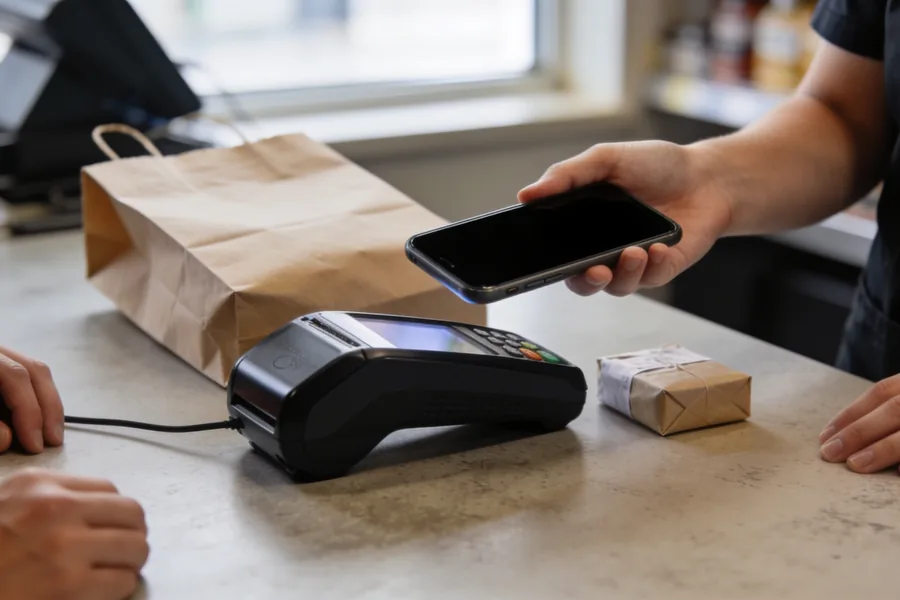

The schedule is not a decision, either. Four payments over six weeks is a rhythm the checkout sets, and the decision is whether a second arrangement starts before the first one finishes.
The merchant pays the provider for the service. That is why nothing at the counter feels like borrowing, and why the price of the service never appears on the sign. It appears later, by type.
MoneySmart lists the fees that can apply: late fees, monthly account-keeping fees, payment processing fees and establishment fees. Those are the provider’s fees, and they are only half of the list. That is four types of fee from one provider, before the bank gets involved, and none of them appears in the advertising.
The bank-side costs sit on top of them. If the account cannot cover a repayment, an overdrawn fee can follow. If the repayment is made on a credit card, card interest can follow it. A repayment moved onto a card is a repayment that can start costing money at both ends. Both lists are knowable in advance.
None of that is hidden, and none of it is unusual. It is simply not at the counter, and it does not need to be there, because the decision is made in four seconds and the fees arrive in four weeks.
The shape is a convenience fee, spread out and named differently in each clause. That does not make it wrong. It makes the contract something to read.
A worked example makes the shape clearer, without a dollar in it. A repayment that lands on a card is both a repayment and a card balance, and the card balance can start costing money from the day it is created.
The instalments are only one part of the cost. The card behind them and the date they land are the other two.
The four-second decision is what the checkout is designed for, and the design is not the problem. The problem is that nothing in those four seconds mentions a credit file.
The credit file question, answered
The answer is in the source’s own terms, not the marketing’s.
Every time a person applies for buy now pay later, it may trigger a credit check. That much is routine. The problem is volume: a lot of credit checks on a report can influence a credit score and act as a red flag for lenders.
The arrangement, any late fees and the application may appear on the credit report. Lenders consider that history when a person applies for something larger, such as a car loan or a mortgage.
Read that list slowly, because it is wider than it looks. The arrangement, the fees attached to it and the application that created it are all candidates for the report. None of them is a missed payment, and all of them can still show up.
Late or missed payments can be reported, and they can reduce a credit score. That is the sentence that matters most, and it is the one the advertising never mentions.
The word doing the work in all of it is may. It is not will, and it is not never. That is the whole nuance, and it is enough to change how a sensible person uses the service. The may word cuts both ways. It is a caution rather than a ban, and it is answered by habits rather than by avoidance.
So there are three credit-file events to keep apart: a missed payment, a run of applications, and the arrangement itself. They are not the same event, and the source treats them differently. What matters is knowing which of the three a person is creating on any given day.
The events are also cumulative in a way that is easy to miss. A single application is one line; a habit of applications is a pattern, and a pattern is what a lender reads. None of this is exotic. It is the ordinary way credit files work, and the arrangement is now ordinary enough to be part of them.
A person who clears every instalment on time builds nothing on their file and damages nothing on it, which is the boring truth underneath all the noise.
The moment this lands hardest is the moment of a bigger decision. A lender weighing a car loan reads the same file and asks the same questions, and the site’s piece on whether refinancing a car loan is worth it works through what a file has to show before a larger commitment is made. The same file, read from the funding side, is the subject of the site’s guide to truck finance that grows with a business.
That is also when the arrangement stops being theoretical: the application that felt like a checkout is, in that file, an application, and the file keeps a memory that the checkout does not.
The verdict is narrow, and it is not an argument against buy now pay later. The file is not damaged by using the service well. It is damaged by missing a payment, and it is damaged by applying everywhere at once.
The fee caps most people never check
Some buy now pay later arrangements must have limits, or caps, on the fees they can charge. That protection exists. Most users have never looked for it.
The way to know whether it applies to the arrangement in front of you is to check the contract, which is the document nobody opens. That is the whole instruction. Check the contract.
If the contract is not at hand, that is the first problem to solve. An arrangement whose terms a person cannot find is an arrangement running on trust, and trust is not a fee cap.
The other half of the same point is what the advertising claims. Interest free is a statement about one type of fee. It says nothing about late fees, account-keeping fees, processing fees or establishment fees, and it says nothing about what happens to a credit file when a repayment is missed.
Fee caps are also the reason the contract matters more than the counter conversation. The person at the counter cannot tell you the cap; the document can.
A cap is not a discount, and it is not a promise that the arrangement is cheap. It is a ceiling on one category of charge, and knowing whether yours has one is the first question on the list below. The contract is also the only place the answer exists; there is no app screen that shows a cap and no counter conversation that settles it.
The quieter option: lay-by
MoneySmart makes a comparison most people have not considered. Lay-by has no account-keeping fees and no late fees, which makes it the cheaper shape for the same purchase.
The trade is the take-home date. With lay-by the goods stay behind the counter until the final payment rather than coming home on the first one. For anyone who knows the money will be paid off either way, that is a straight trade.
Lay-by is the slower shape and the cheaper one, and it is the comparison the source puts on the table. It asks for patience and gives back the fees. The trade is old and unexciting: pay first, take the goods later. It will not suit everyone, because the goods stay in the shop, and for some purchases the waiting is the whole objection.
When it goes wrong, ask early
The failure mode is rarely the fee. It is the silence after a missed payment, which is the point at which a conversation is still possible.
All buy now pay later providers are required to have complaints and hardship services, which means there is a route to take before a missed payment becomes three. MoneySmart’s instruction for financial hardship is to take action straight away and ask the lender for hardship assistance, then consider the options offered and make the arrangement. Asking for that assistance is a normal use of the process the providers are required to keep, and using it early is what keeps a small problem small.
Asking early keeps it a conversation. Asking late is where a missed payment can reach the credit file.
The order of the steps matters as much as the steps themselves. Take action, ask for assistance, consider the options, make the arrangement: the source sets it out in that sequence, and each step depends on the one before it.
Financial counselling is free and confidential, through the National Debt Helpline on 1800 007 007, weekdays from 9:30am. It exists for exactly this situation, and reaching for it is a practical decision rather than an admission.
What to check before you tap
Four questions, before the next purchase. They take five minutes, and each one has a reason behind it.
- Is there a fee cap in the contract, and does the contract say so in plain words? Some arrangements must carry one, and the contract is where it lives.
- Which card sits behind the repayment, and what happens on the due date if that card is empty? An overdrawn fee and card interest both start with that card.
- How many services are running at once? MoneySmart’s own warning is that multiple services are hard to manage, and a person running three is running three deadlines.
- What is the plan if this month goes wrong? The providers keep hardship services for that question, and an answer is easier to reach before it is needed than after.
None of the four takes long, and each one is cheaper than the alternative it prevents. That is the whole argument for the five minutes before the tap.
The checklist is short on purpose. A long list before a small purchase would be its own kind of noise, and the four questions above are the ones with money attached. They also get faster with practice: the first tap after the checklist takes five minutes, and the ones after it take two.
The service is a payment method, not a trap. It is a payment method with a credit file attached, and a credit file is the part that follows a person to the next loan application. Tap with that in mind and the arrangement stays what it was sold as.
Sources: MoneySmart – Buy now pay later services · MoneySmart – Financial hardship