Home & Garden
What to Prune in June, and the Plants That Hate It

The secateurs are out, the last flowers have gone, and one question is keeping you indoors: is it too early? That worry is a reasonable one, and it deserves a straight answer. Cut a rose back a week before the frosts arrive and the new shoots come away soft; the next cold night takes them, and you spend spring looking at the damage. Here is the reassuring part. The timing is a window rather than a skill, and it is wide enough for most gardens. In most of Australia, the best time to prune roses is June or July. If you live in a really cold area, the advice is to wait until early August, so the frosts do not knock back the new shoots. Most gardens sit comfortably inside that window, and the difference between cutting this weekend and next weekend is far smaller than the difference between cutting now and cutting in May.
It also helps to know which prune you are doing. Roses want attention at least twice a year: a summer dead-heading, where each spent flower is snipped a few centimetres below the bloom, and the harder winter cut that shapes the plant for the season ahead. The June and July question is about the second of those, and it is the one where timing matters. The summer job is forgiving. The winter one is not, because it happens next to the cold. You do not need to be an expert to get this right. You need a pair of sharp secateurs and a week without frost.
One catch sits under all of that, and it is why this question never has a single date. Winter means different weeks in Cairns, in Melbourne and on the Tablelands, and local frost decides your week rather than the month on the calendar. Check the forecast before you check the date.
Why winter is the right season for the hard cut
Winter pruning works because the plant is resting. It is dormant, so the cuts are open but new growth is slow to arrive, and fewer pests and spores are moving about. The frost rule comes from the same place: it is not the cut itself that damages the bush, it is the soft growth a cut encourages too soon, before the cold has finished with your garden. Patience here is not caution for its own sake. It is the whole technique.
The second reason is air. Opening up the centre of the bush so there is more air circulating is a disease measure, not a tidying one. Air moving through the middle, and light reaching the wood, are the point of the exercise, and anything overhead changes how much light gets through. If your roses grow under a patio or a carport, the site’s guide to polycarbonate roofing over a garden is clear about what a cover does and does not change for the plants below it.
There is one more quiet benefit to cutting in winter. With the leaves gone, the frame of the bush is bare, and the shape it will carry into spring is finally visible. That is why this is the cut that sets the structure, and why a few minutes spent looking before the first cut is time well used.
The four cuts that do the work
Four cuts, in this order, do almost everything a winter prune needs to achieve. Work from the top of the bush downwards, and step back between cuts to look at the shape you are making.
- Anything dead, or anything showing dieback, right down to stump level. A stub left below a dead stem is no use to the plant, so take the cut back to sound wood.
- Spindly stems. Follow each one down until it is about the thickness of a biro, and remove it there. These are the stems that will not carry a flower worth waiting for, and they take light and air from the ones that will.
- Anything crossing or crowding the centre. Where two stems rub, keep the one growing outward and take the other, so the middle of the bush opens up and the air can move through it.
- The water shoots, and only lightly. These are the young stems, olive green or pink, and they are where the flowers come from, so they get a tidy rather than a haircut.
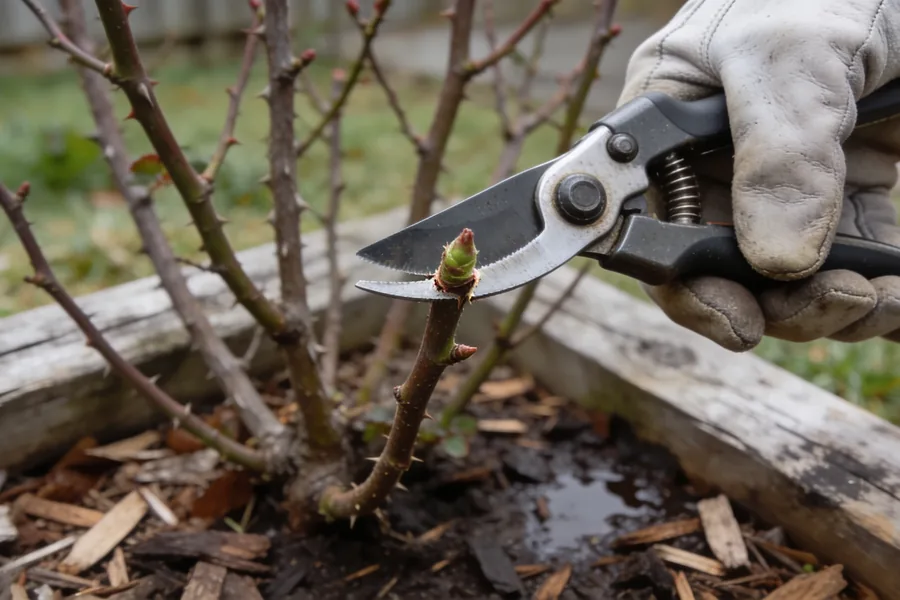
When you make the cut, aim for about a 45 degree angle above an outward facing bud, sloping away from the bud. Rain and dew then run off instead of collecting where the new shoot will form, which is a small thing that helps keep fungal disease away from the wound. The outward-facing part matters for the same reason as the centre cut: the new shoot grows away from the middle of the bush rather than back into it. Work through the four in order, and stop when the middle is open and the strong stems are clear.

How hard to go
How far back you go is a judgement, and the sources offer a scale rather than a rule. If you are a cautious pruner, take about a third off. If you are confident, or the bush has run wild, you can go back by about half. Both are given as sensible choices, so pick the one that matches your confidence and the rose in front of you.
What does not flex is the direction. Cut from the top, and cut to a bud that faces the way you want the new shoot to grow. Every cut is a decision about next season’s shape, which is why stepping back matters more than cutting fast.
There is one more piece of restraint in the sources. Do not rush the winter prune. Let the plant rest first, so the last flowers are enjoyed and the young stems have time to harden off before the cold settles in. A bush pruned in a hurry is a bush that spends winter working instead of sleeping.
And if the two options still feel far apart, the choice comes down to confidence and to the bush in front of you, which is how the source frames it, rather than to a number that has to be exact. A third and a half are both inside the practice. The window matters more than the depth.
The roses that play by different rules
Not every rose in the garden wants the same treatment, and the differences are worth knowing before you start on the row.
- Heritage roses need very little. A light shape, a tip prune and anything dead removed is the whole job, and nothing more is asked of them.
- Ground cover roses can be cut back almost to ground level. They regrow by spring, particularly with fertiliser and mulch through the warmer months.
- Repeat flowering roses are pruned three or four times in a season. The winter prune is the hard one; the others are lighter, and it is the severity that changes, not the technique.
The three or four prunes in a season are not three or four winter prunes. The hard cut happens once; what follows is the light tidying after each flush of flowers, and the bush barely notices it.
The caution from the sources deserves repeating here. In a frost-prone area, leave the pruning until the chances of frost are over. Prune early, and the warm spell that follows can push new growth straight into the next cold night. If the bush has not finished dropping its leaves, it has not finished resting either, so wait.
One more case needs naming, and it does not fit a rule. If your rose flowers on last season’s wood, the winter prune is a different conversation, and it is a question to ask about your own plant rather than something a page can settle. Take a photo of it in flower, ask at a nursery, and prune the rest of the row while you wait for the answer. That is not a gap in the advice, just the limit of what advice can do without seeing the plant.
What to do with the prunings
The prunings go to the bin or the mulch pile. If you have small children at home, sorting the garden waste is one of those jobs they can genuinely take part in, and the site’s piece on recycling ideas for preschoolers turns the sorting into something closer to a game than a chore.
The one thing not to do is feed or water the bush heavily straight after the cut, hoping to push it along. The growth that encourages is soft growth, and soft growth is what the frosts are looking for. Hold the heavy feeding until the cold has passed and the plant is ready to use it. The same restraint applies to water. The instinct after a hard cut is to give the plant something to work with, and the season says otherwise.
Where to make the first cut
Before you start, three checks, and together they take about five minutes.
- Is there a frost forecast in the next week or two? If there is, wait, or start with the roses that sit outside the frost pocket.
- Has the bush lost its leaves? If it is still holding them, it has not finished resting yet.
- Are the secateurs clean and sharp? The job is hard enough without fighting the tools.
Then start where the answer is easiest: the dead wood. The first cut is the one that feels like a decision, and a dead stem is the one cut nobody can get wrong. After that the bush tells you what it needs, and you will wonder why you put it off. And if the forecast turns, nothing is lost by waiting a week. The window is June and July for most gardens and early August for the cold ones, and it will still be open when the frost has gone.
If you are new to roses, the first winter is the one where every cut feels like a risk. Start with the dead wood, take the spindly stems after that, and leave the water shoots alone until you have watched them flower once. The next winter will feel like routine.
If the forecast looks clear and the bush has dropped its leaves, you are ready. Start at the top of the bush, work down, and let the first cut tell you how the rest will go.
Sources: Gardening Australia – Rose Pruning · Heritage Roses in Australia – Rose Pruning