Healthcare
Bluebottle Stings: Hot Water, Not Vinegar, and When It Is Something Worse

You’re standing at the water’s edge with a crying child, a red welt rising on their leg, and three different people on the sand telling you three different things. Vinegar, says one. Rub it with sand, says another. Someone further up the beach is recommending something you’d rather not repeat. And you’re left holding a hot, upset little person and wondering which of them is right.
If that’s where you are, or where you’re worried you’ll be this summer, take a breath. The confusion is real, and it isn’t your fault. The advice about jellyfish stings in Australia genuinely changes depending on where you are in the country, and most of the remedies passed around on beaches were meant for a different animal, a different coastline, or no animal at all.
The good news comes first. Healthdirect, the government-funded health information service (its jellyfish page was reviewed in October 2024), says most jellyfish stings are painful but not dangerous. And once it’s laid out, the rule is simpler than the beach chatter makes it sound. In non-tropical waters, a bluebottle sting gets a sea water rinse, the tentacles come off, and then hot water. In the tropics, an unknown sting is treated as a box jellyfish: vinegar and hospital. Everything below is that rule, unpacked slowly, with room for the questions you’re probably already asking.
Is it a bluebottle?
Bluebottles are also called the Portuguese man-of-war. Healthdirect says they’re common along the east coast, especially in Queensland and New South Wales, and anyone who has walked the tide line after a windy day on the east-coast beaches where so much of Australia spends its summer has probably seen them: small, bright blue floats like tiny balloons, with long blue tentacles trailing behind.
The sting usually makes itself known. Healthdirect describes intense pain that can last for an hour or more, and a red line on the skin where the tentacle touched, which can last a day or more. That line is often the clue people notice first.
You might be thinking that you didn’t see what stung you, and that’s fair. Plenty of people don’t. A sting in the shallows happens under the water, and whatever caused it is easy to miss.
So here’s a small thing to do: look along the sand nearby. If blue floats have washed up on the tide line, a bluebottle is a likely suspect.
First aid for a bluebottle sting
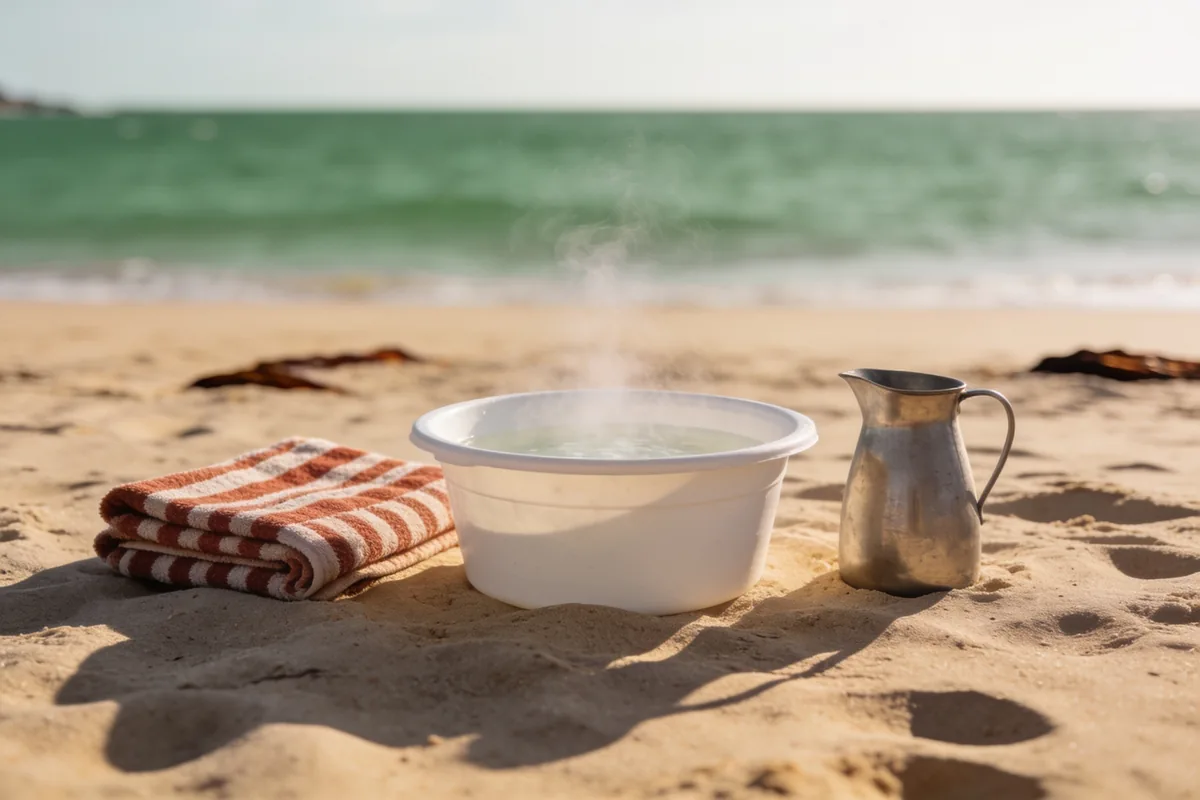

Here is what healthdirect recommends, in order.
- Wash the area with sea water, not fresh water. Use the water you’re standing next to.
- Remove any tentacles. You can pick them off with your fingers, or wash them off with more sea water.
- Put the stung area in hot water. Healthdirect gives the temperature as 45 degrees C, for 20 minutes. Make sure the water is not so hot that it will burn. Test it with your own hand before the stung limb goes in.
- If you can’t get a tub of hot water, use a hot shower or hot running water instead.
Healthdirect is clear that hot water works better than ice packs for bluebottle pain. That might surprise you if you grew up putting ice on everything, and it’s okay to feel a bit wrong-footed by it. The evidence is there, though.
The Royal Australian College of General Practitioners includes topical heat for bluebottle stings in its Handbook of Non-Drug Interventions, known as HANDI. The recommendation is based on a randomised trial, rated at NHMRC Level 2 evidence. HANDI adds some practical cautions that are worth knowing before you start. The heat needs to be applied quickly to help. Some people find they can’t tolerate the temperature. And there has been one thermal burn recorded, which is exactly why checking the water before a stung limb goes in matters so much.
If your child can’t bear the water at first, that’s understandable. Let them lower the limb in slowly, and keep a hand nearby to test that it’s warm rather than scalding.
If you’d like one thing to do before your next beach day, make it this: if there’s a café, a surf club or a shower block nearby, find out where the hot water is before anyone goes in.
Why not vinegar, here
This is the part that trips most people up, so please don’t feel silly if you’ve always reached for the vinegar. Plenty of us were taught that, and for some stings in some places, it’s right. For a bluebottle, it isn’t.
Healthdirect says vinegar may increase the pain of a bluebottle sting. HANDI goes further and lists the things that may trigger more discharge from the stinging cells: alcohol, vinegar, and rubbing the area with a towel or with sand. So the well-meaning person scrubbing your child’s leg with a handful of sand may be making it worse, not better.
Fresh water is on the same list for a slightly different reason. Healthdirect explains that fresh water can set off stinging cells that are still left on the skin. That’s why the first step is sea water, even though a bottle of drinking water might be the first thing to hand.
And one more thing that sometimes gets mixed up. A bluebottle sting does not need a pressure bandage. That kind of bandage is the right first aid for some bites, including a brown snake bite, but it isn’t used for a bluebottle. If someone on the beach starts reaching for a bandage, you can gently say no.
If you carry a little kit in the beach bag, the change is small. Take the vinegar out of your bluebottle plan, and leave the bandage for the bites it’s meant for.
North of Bundaberg and Geraldton, the rules change
Now for the part that explains why the advice feels so contradictory. Australia has more than one kind of dangerous jellyfish, and they live in different waters.
Healthdirect draws a line across the map. In the north of Australia, north of Bundaberg in Queensland and north of Geraldton in Western Australia, any unknown sting should be treated as a box jellyfish sting. That’s a different situation from a bluebottle on a southern beach, and it needs a different response.
For a major box jellyfish sting, healthdirect’s steps are:
- call 000
- start CPR if the person is unconscious
- remove the tentacles
- pour vinegar on the sting site once the tentacles are off (healthdirect explains that vinegar deactivates the stinging cells)
- use ice packs for the pain
- get to hospital
So vinegar does have a place. It just belongs to the tropics and the box jellyfish, not to the bluebottle on a southern surf beach.
There’s also Irukandji syndrome to be aware of. Healthdirect explains that symptoms can begin 20 to 30 minutes after a sting, and the sting itself may not even be noticed. The symptoms include severe pain in the back, chest and muscles, a fast heart rate, high blood pressure, anxiety and nausea. If that happens after swimming in tropical waters, go to hospital.
Stinger season usually runs from late spring to early autumn, although it varies from place to place. If you’re holidaying up north, ask the locals and the lifeguards what the season looks like where you’re staying.
The step to hold on to up north is the simplest one. If anyone is stung in tropical waters, call 000. You don’t need to be sure what it was first.
When a bluebottle sting needs a doctor
Most jellyfish stings are painful rather than dangerous, as healthdirect says. Still, it’s completely reasonable to want to know when to stop managing it yourself.
Healthdirect suggests seeing a doctor if:
- the pain is severe and isn’t getting better, or other symptoms appear
- blisters form that need dressing
Rarely, healthdirect says, a bluebottle sting causes abdominal pain, muscle pain or breathing problems. That happens in fewer than 1 in 100 people. It’s uncommon, but it’s worth knowing the signs. If anyone has difficulty breathing, call 000 straight away.
If you’re simply unsure and want advice, the Poisons Information Centre is on 13 11 26. You can call them from the beach, and it’s okay to ring even if you think you might be overreacting. That’s what the line is for.
Something you can do in the next minute: save 13 11 26 in your phone, alongside 000, so you’re not searching for it with a crying child on your hip.
Keeping the day on track
None of this needs to put you off the beach. A few habits make a sting less likely, and much easier to handle if it does happen.
- Swim at patrolled beaches. Lifeguards can give first aid, and they’re the people to ask about what’s been washing in.
- Stay out of the water when warnings are up. If the beach has stinger warnings, it’s fine to have a sandcastle day instead.
- In the north, wear a full-body suit or a stinger suit when you swim.
- Don’t touch jellyfish on the sand, including bluebottles that look washed up and harmless. Teach the kids to look and not poke.
It helps, too, to pack the beach bag with the whole day in mind. Hats and sunscreen go in first, and if you’ll be staying into the evening or heading on to a campsite, the right mosquito repellent for where you're going belongs in there as well.
And a gentle last step for this section: next time you’re at a patrolled beach, point out the flags and the lifeguards to your kids, so they know where to go if something stings.
Sea water, hot water, and a lifeguard
If you take nothing else away, take this. For a bluebottle sting on a non-tropical beach, rinse with sea water, take the tentacles off, and put the area in hot water at 45 degrees C for 20 minutes, checking first that it won’t burn. Skip the vinegar, skip the fresh water, skip the sand, and skip the bandage.
North of Bundaberg and Geraldton, treat any unknown sting as a box jellyfish: call 000, remove the tentacles, use vinegar, and get to hospital.
And wherever you are, swim where there’s a lifeguard. You don’t have to remember every detail of this when it happens. The people in the red and yellow will, and they can help you take it from there.
Sources: Jellyfish stings, healthdirect (https://www.healthdirect.gov.au/jellyfish-stings); Topical heat for bluebottle stings, RACGP Handbook of Non-Drug Interventions (https://www.racgp.org.au/clinical-resources/clinical-guidelines/handi/a-z/t/topical-heat-for-bluebottle-stings)