Food
Why a Sourdough Starter Asks You to Throw Half Away

It is a little after seven on a spring morning, and the kitchen still holds the night’s cold, though the light through the window over the sink has already turned the bench a pale gold. A glass jar sits beside the kettle. Three days ago it held nothing but wholemeal flour and tap water, stirred into a grey paste that looked like wallpaper glue. Now bubbles press against the glass, the top has lifted into a loose dome, and when you ease the lid off, the smell is somewhere between plain yoghurt and a cut apple. Something in there is alive.
Then you read the next line of the recipe. It tells you to pour half of it away.
Most people pause here with the spoon in their hand and feel a small pang of waste. Three days of feeding, and the first real instruction is to tip your progress into the bin. It sounds like a ritual passed down without a reason, the sort of thing bakers do because the person who taught them did it too. There is a reason, though, and once you see it the discard stops feeling like a loss. It is mostly arithmetic. The rest is about food.
What is actually in the jar
A starter is flour and water that something has moved into. Wild yeasts and bacteria ferment the flour, and the gas they give off is what fills the paste with bubbles and pushes it up the side of the jar, as Clemson University’s Home and Garden Information Center explains in its guide to sourdough discard. Leavened bread turns up in one form or another across a great many of the world’s kitchens, and if you have ever gone on a journey through diverse cuisines, you have probably eaten bread raised by a jar much like this one.
Not every starter is the same, and in 2021 a group of researchers looked at how they differ. They studied 500 starters gathered from four continents and published the results in the journal eLife. Place, it turned out, mattered less than you might expect. There was little sign that a starter’s location shaped what lived in it; how the starter was made and kept looked more important than where it came from. One group of microbes did stand out. Acetic acid bacteria were linked to a sharper, vinegary aroma and to a slower rise.
If your jar leans towards vinegar and takes its time, that pairing is one the researchers saw.
If you arrived at sourdough because someone told you fermented food is good for you, that is a different question, and a bigger one. Our look at gut health, what the evidence supports and what to be sceptical of is the place to weigh it. This jar has a smaller job. It only has to raise bread.
The arithmetic behind the discard
Clemson’s guide puts the problem in grams, and it is worth following slowly. Say you keep 30 g of starter and feed it 30 g of flour and 30 g of water. Skip the discard, and the next feed starts with 90 g in the jar.
Now picture the morning after that, and the one after that. Each feed has to match the starter it is feeding, so every skipped discard asks for more flour and more water than the one before, and a jar that began with a few spoonfuls is climbing past its shoulder by day four, then over the rim and down the side by day five, leaving you scraping paste off the bench and wondering where the flour went. At that point the starter is running the kitchen.
The second reason comes from King Arthur Baking, whose starter method this piece follows. Keeping the total amount of starter down means each feed brings more fresh food for the yeast. A small starter given a full meal gets busy. A large one given the same meal goes hungry and sluggish, because there is less to go around.
Put the two together and the discard looks less like waste and more like portion control. You are keeping the jar a size you can feed properly.
Day by day, from flour and water
This is King Arthur’s method, in grams, with the Australian names for the flours. You will need a jar, a spoon, flour, water and a set of kitchen scales.
Write the feed times on a scrap of paper and leave it by the jar. Twice-daily feeds blur together quickly, and by day four it is easy to lose track of whether the evening feed happened.
Day 1. Stir 50 g of wholemeal flour (rye works too) into 50 g of water in a clean jar. Cover it loosely and leave it somewhere around 21°C for 24 hours. Do not worry if nothing seems to happen. King Arthur warns that the first day can pass without much sign of life.
Day 2. Weigh out 50 g of the starter and discard the rest. Feed the 50 g you kept with 50 g of plain flour and 50 g of water, stir it well, cover it and leave it in the same warm spot.
Days 3 to 5. Do the same thing twice a day, about 12 hours apart: keep 50 g, discard the rest, feed 50 g of plain flour and 50 g of water. Morning and evening is the easiest rhythm to hold, before work and after dinner.
Ready, or not yet. By the end of day 5, a lively starter will at least double in volume within about 6 to 8 hours of a feed. It will be full of bubbles and smell pleasantly tangy. A rubber band around the jar at the level of the fresh feed makes the rise easy to read. If yours has not got there, keep going through days 6 and 7 on the same routine. On King Arthur’s timetable, then, the answer to how long it takes is five days, with days 6 and 7 held in reserve.
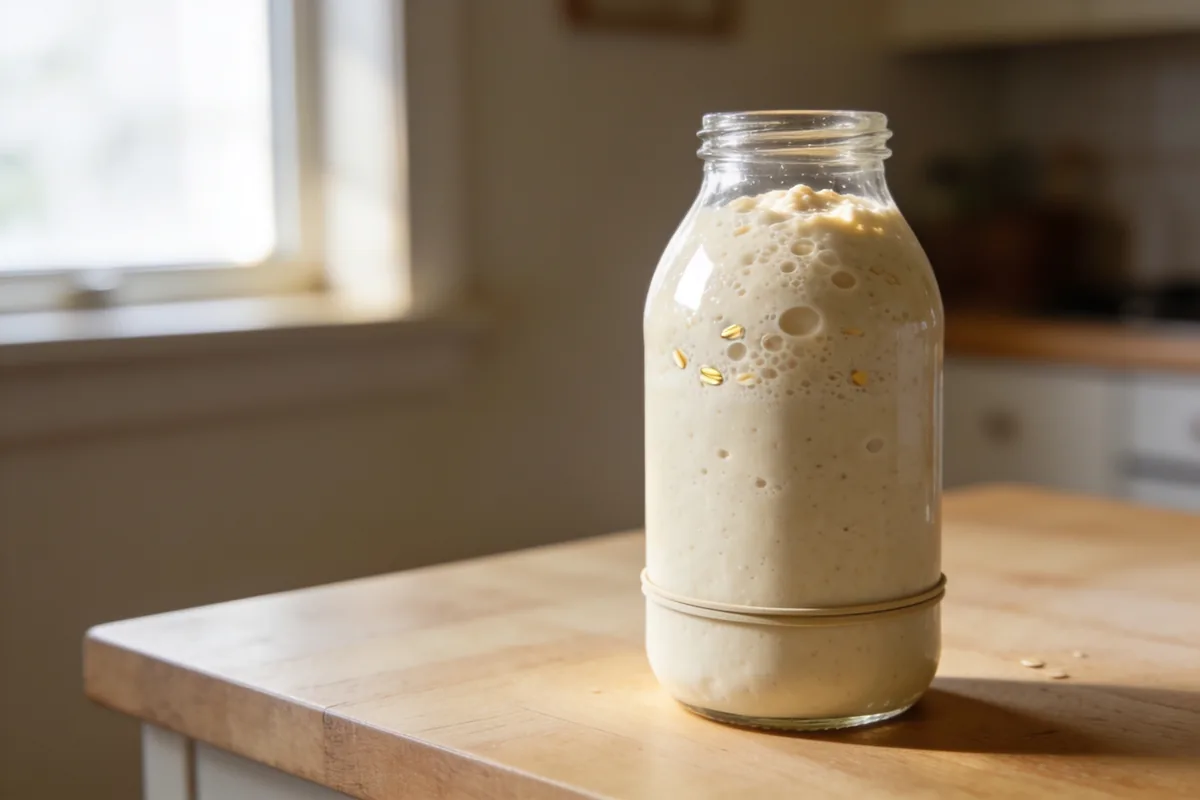

Watching for the rise is the part people remember. You check the band after breakfast, then again at lunch, then lean down to eye level mid-afternoon and see the surface well above it, domed and pocked with bubbles. That is the day the jar stops being an experiment.
Warmth, in an Australian house
Warmth sets the pace. King Arthur puts the ideal range at 21 to 26°C (70 to 78°F), and says that below 20°C (68°F) things slow down, which matters in an Australian spring, when a kitchen can sit cold at dawn and warm up through the afternoon.
A jar beside a cold window on a September morning will move slowly, and it is easy to mistake slow for dead.
King Arthur suggests a couple of warmer spots: inside the oven with only the light switched on, or on top of the fridge. Whichever you choose, check that the starter is not getting too hot. A note taped to the oven door saves it from being baked along with the dinner.
What to do with the half
The first time you do it, it feels wrong. A spoonful of pale, bubbly paste slides off the scales and into a bowl, and it smells just as good as what stays behind.
The half you pour off does not have to go in the bin. King Arthur and Clemson make the same point: it can be given to a friend, or baked into something else. Clemson’s list includes pancakes, crackers, pizza base and cookies. The discard is an ingredient in its own right.
On a slow Sunday morning a bowl of discard becomes a stack of thin, sour-edged pancakes, the batter spreading in the pan and bubbles rising through the tops before you flip them.
It fits into an ordinary week more easily than you would expect, and if you are trying to balance your plate across the week, pancakes and crackers made from discard are one more thing cooked at home from what was already in the kitchen.
There is also a quieter fix. Keep a smaller starter, and there is less to throw away at each feed. A 50 g starter makes far less discard than a jar you have let grow.
When the jar has to go
There is one sign that overrides everything above. If you see mould on a starter, the whole thing goes: not the top layer, not the patch you could scrape away, all of it. The national health advice service, healthdirect, says soft foods like bread should be thrown away if there is any mould at all. A wet, living starter is softer than any loaf in the house. Wash the jar, start again from day one, and treat it as the cost of learning.
What the jar is telling you
It is day five, and the afternoon light has moved round to the other end of the bench. The jar has not moved at all, but everything inside it has: the band you rolled on after the morning feed is well below the surface now, the dome is ridged and glossy, and the smell has softened into something closer to yoghurt than vinegar. You did that with flour, water and a set of scales, and nothing more.
Skip the gadgets. A jar with a loose lid does the job of any purpose-built crock, and a rubber band does the job of any marked container or app. The one habit worth keeping is the dull one: weigh, do not guess. A cup of flour can vary from one scoop to the next, and a starter fed by eye drifts until you no longer know what you are feeding it.
The discard is the jar telling you how much it can use. Pour the rest into the pancake bowl and feed what is left.
Sources: Sourdough Starter recipe, King Arthur Baking (https://www.kingarthurbaking.com/recipes/sourdough-starter-recipe); All About Sourdough Discard: How to Use and Manage Your Starter, Clemson Cooperative Extension HGIC, 2026 (https://hgic.clemson.edu/all-about-sourdough-discard-how-to-use-and-manage-your-starter/); Landis EA, Oliverio AM et al., The diversity and function of sourdough starter microbiomes, eLife, 2021 (https://elifesciences.org/articles/61644); Accidentally eating unsafe foods, healthdirect (https://www.healthdirect.gov.au/amp/article/accidentally-eating-unsafe-foods-ingesting-questionable-foods)